What does it take for a traditional Japanese trading giant, a renewable energy conglomerate, regulated Hong Kong banks, and a decentralized oracle network to write checks into the same blockchain infrastructure company at the same time?
That question sits at the center of Pharos Network’s announcement today. The Hong Kong-based financial Layer 1 has closed a $44 million Series A round, bringing its total funding to $52 million. The investor list reads less like a typical crypto venture round and more like a cross-section of the institutional world that blockchain has spent a decade trying to court.
What Pharos Is Building, and Why It Is Different From Most Layer 1s
Most Layer 1 blockchains are built as general-purpose platforms, meaning they try to do everything for everyone. Pharos is built for one specific problem: bringing real-world assets (RWAs) onchain at institutional scale.
To understand why that distinction matters, consider what a real-world asset actually is. A government bond, a solar energy project, a commercial property, a private equity stake. These are assets that exist in the physical or legal world, governed by contracts, courts, and regulators. Putting them onchain means creating a digital token on a blockchain that legally and technically represents ownership of that underlying asset. Think of it like a title deed, except the title deed can be traded in seconds, held in fractions, and verified by anyone.
The problem is that most blockchain infrastructure was not designed with this use case in mind. Pharos, founded by the former leadership of Ant Group and backed by engineers from Microsoft Research and Stanford, claims to have built its architecture specifically around the compliance, speed, and auditability requirements that institutional capital demands. The network uses what it calls a deep-parallel execution engine, a technical design that processes multiple transactions simultaneously rather than sequentially, targeting performance at internet scale.
The Investor Mix Tells a Story
The Series A investor list is worth examining closely because it represents something unusual in the blockchain funding landscape.
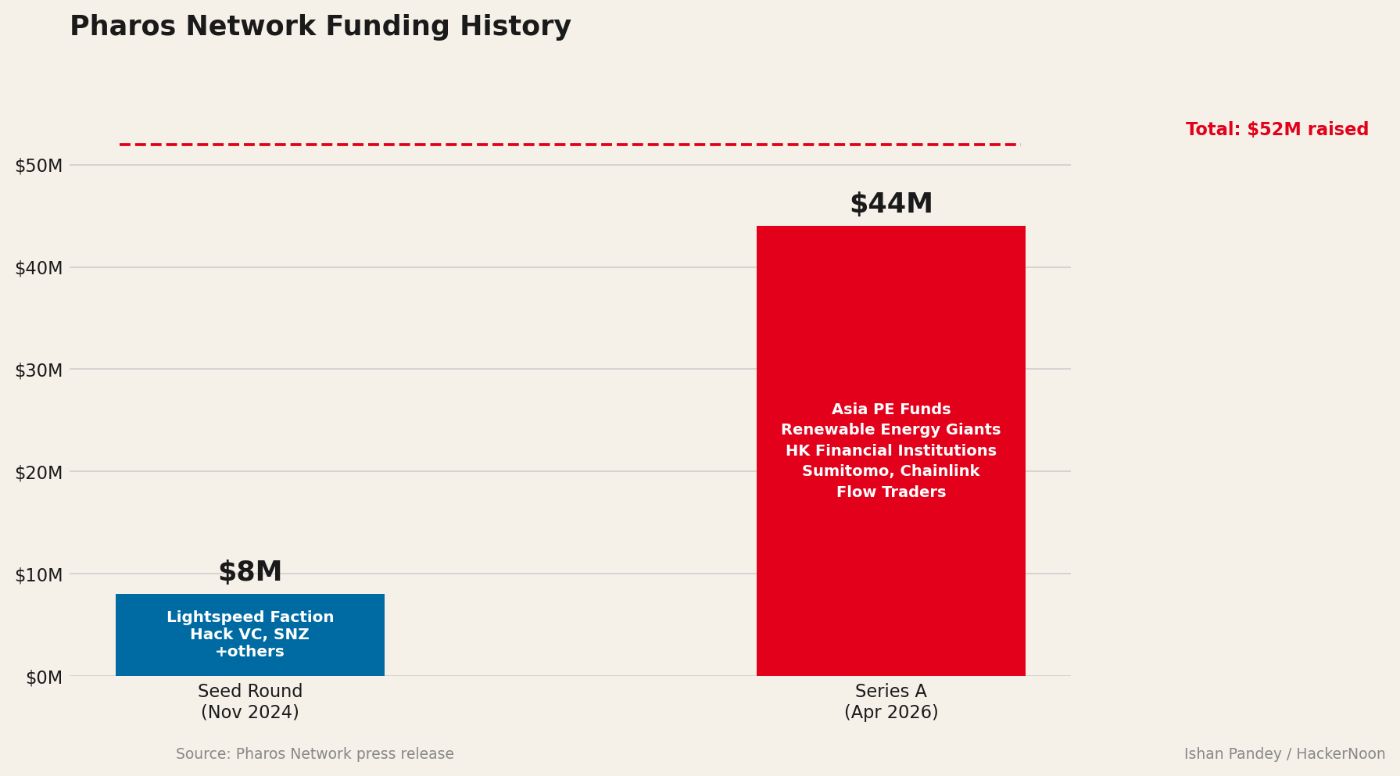
Sumitomo Corporation, one of Japan’s largest Sogo shosha (a Japanese term for a diversified trading conglomerate that manages businesses across industries, from energy to finance to logistics), is participating through a subsidiary. Sumitomo has revenues exceeding $60 billion annually and operations in over 60 countries. Its involvement signals that Pharos has cleared the compliance and governance bar required for a Fortune Global 500 company to put its name on a blockchain infrastructure investment.
Chainlink, which has positioned itself as the standard infrastructure layer for bringing capital markets onchain, with UBS and J.P. Morgan among its institutional adopters, is also a strategic investor in the round. Flow Traders, one of the world’s largest electronic market makers with deep roots in ETF and fixed-income liquidity, rounds out the crypto-native side. Their presence suggests the round was not driven by speculative interest in a token, but by a view on infrastructure positioning in a market that is growing fast.
The round was led by a consortium described as including premier Asia-based private equity funds, publicly traded renewable energy companies, and regulated Hong Kong financial institutions. Their identities are undisclosed, but the structure mirrors the kind of consortium that backs regulated financial infrastructure, not the retail-driven funding rounds that characterized earlier crypto cycles.
This follows Pharos’s earlier strategic capital partnership with GCL New Energy Holdings, a publicly listed Hong Kong solar and energy storage giant, to pilot energy-backed RWAs. That transaction was completed after satisfying full Hong Kong Stock Exchange regulatory disclosure requirements, a compliance standard that most blockchain projects never reach.
The Market Timing Is Not Accidental
The funding arrives at a moment when the RWA tokenization market is crossing a meaningful threshold.
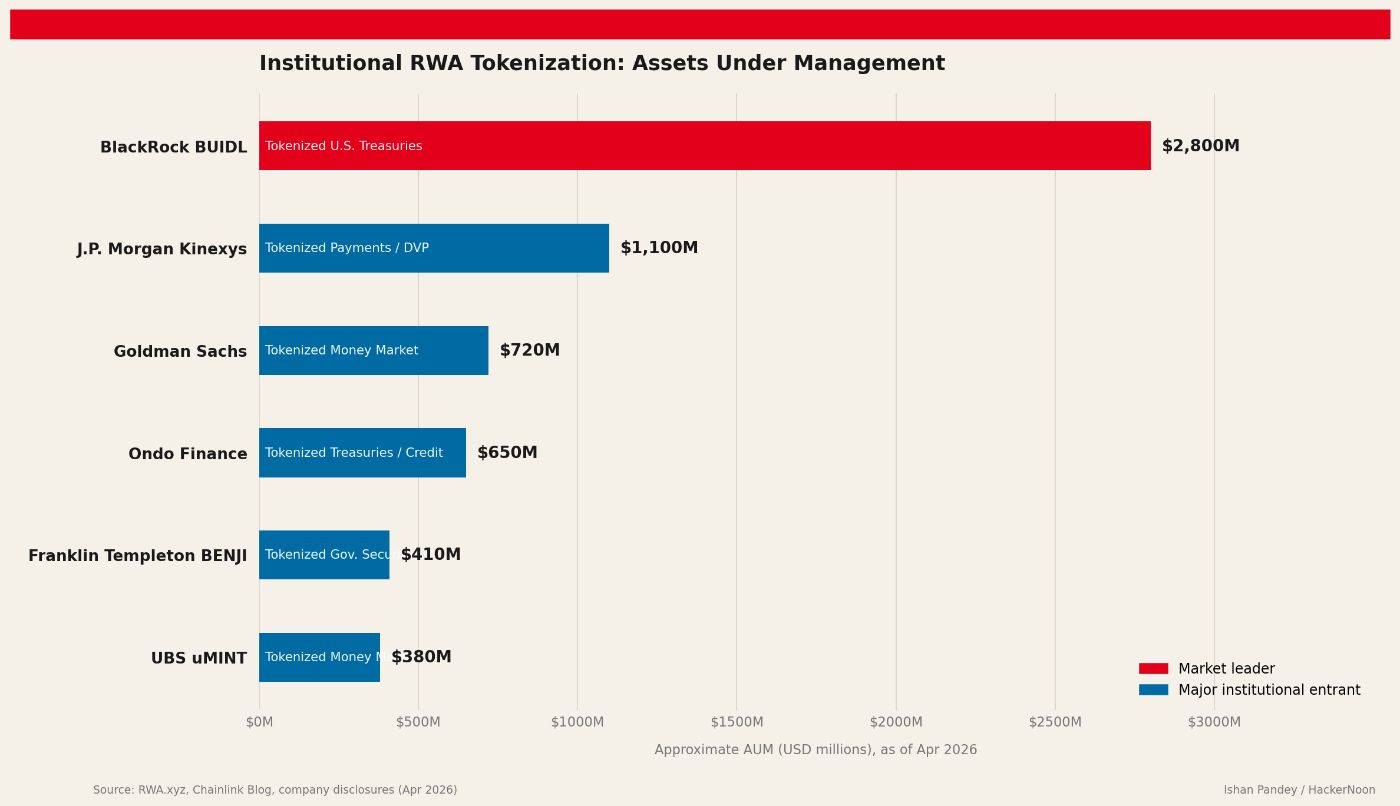
The tokenized RWA market, excluding stablecoins, reached between $19 billion and $36 billion in early 2026, following growth exceeding 300% in recent periods. Projections point toward $100 billion by year-end, led by tokenized U.S. Treasuries. That number is significant not because $100 billion is large relative to global asset markets (it is not), but because it marks the point at which tokenization stops being a pilot and starts being a product.
Longer-range forecasts are more consequential. The global tokenized RWA market was valued at $297 billion in 2024 and is projected to reach $612 billion by end of 2025, with analysts forecasting $9.43 trillion by 2030 at a 72.8% compound annual growth rate. BCG and Ripple take a more conservative view, projecting $18.9 trillion in tokenized assets by 2033.
Pharos CEO Wish Wu, Co-Founder and CEO of Pharos Network, describes the moment,
“This funding allows us to scale RealFi from narrative to execution. We are formalizing how institutional capital, risk governance, and onchain infrastructure come together on a financial-grade Layer 1. With our strategic partners, we are building an environment where real-world assets can operate at scale with institutional-grade reliability.”
Testnet Numbers and What They Signal
Pharos is currently live on its Atlantic Ocean Testnet, which the company describes as providing a mainnet-equivalent view of performance. The network has onboarded millions of users and hundreds of millions of unique addresses.
Those numbers require context. Testnet activity is not the same as mainnet activity, and onboarding incentives often inflate user counts in the crypto industry. What matters more is the composition of the ecosystem being built.
According to the company’s documentation, Pharos is building toward deep-parallel execution with built-in compliance, meaning the network is designed so that regulatory checks are part of the protocol itself rather than a layer bolted on afterward. For institutions that are legally required to know their counterparties and report transactions, this is not a minor feature. It is a prerequisite.
The ecosystem page shows early-stage applications across RWA lending, DEX infrastructure, stablecoin tools, and tokenized securities, indicating that the network is not waiting for mainnet to attract builders.
Final Thoughts
The Pharos funding round is analytically interesting for one reason above all others: the investor composition is a proof point, not just a capital event. When a Fortune Global 500 trading conglomerate, a public-market energy giant that had to file regulatory disclosures to make its investment, and an oracle network that secures over $100 billion in assets all appear on the same cap table, it suggests that institutional due diligence has been done. These are not investors writing speculative checks into a whitepaper. They are organizations with compliance teams, legal departments, and fiduciary obligations.
The RWA tokenization market is at an inflection point where infrastructure quality will determine which platforms capture institutional flows. The RWA market expanded 380% from $5 billion in 2022 to $24 billion in early 2025, and analysts project $100 billion to $150 billion by end of 2026 under steady institutional adoption scenarios. The platforms that can demonstrate compliance-native design, high throughput, and the kind of institutional relationships that Pharos has assembled will be positioned to handle the capital that follows. Whether Pharos executes on that positioning is a question that only mainnet performance can answer, but the foundation being laid here is structurally different from most of what the Layer 1 space has produced.
Don’t forget to like and share the story!