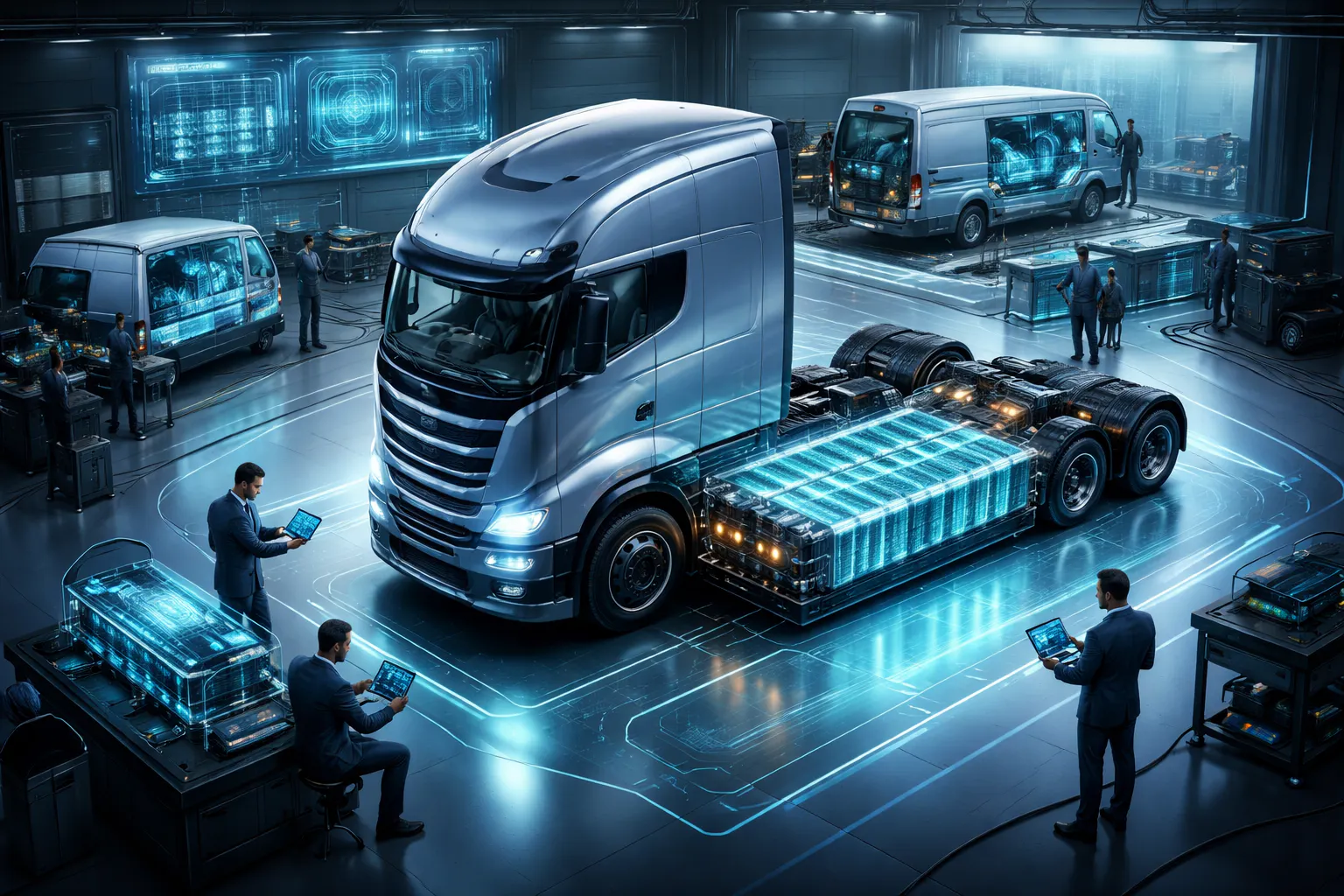
Electrification of commercial automobiles is transforming the transportation industry at a pace that cannot be imagined, but it has brought with it numerous engineering challenges that extend far beyond the mere fact that batteries have to be installed where internal combustion engines used to be. Electric trucks and buses operate on large battery packs that weigh between 500 kg and 4,000 kg, which is significant for a heavy-duty vehicle and demands a lot of space, thermal control, and efficiency. A solution to all these issues is, however, offered by a radical innovation that looks at converting battery systems into commercial vehicle platforms that provide structural support and thermal control as a single solution.
The Problem with Conventional Battery Systems
Commercial electric vehicles use traditional battery integration systems which are stacked or layered. In this type, the structural frame is secured on top of the chassis first, then a cooling plate is secured before finally the battery modules are attached on top of it. This can be functional but has a number of inefficiencies.
Excess weight is one of the biggest disadvantages. The division of components to carry the structure and take part in cooling leads to what engineers call dead weight, since this decreases the capacity and efficiency of the entire vehicle. Its ineffectiveness directly affects the cost and efficiency of operations in commercial transport, where mass is counted in kilograms.
Stacked systems are also known to have a number of interfaces and fasteners, which leads to mechanical breakdown over time. This can cause loosening of bolts, wear and tear of materials, and even leakage of coolants due to constant vibration, long usage, and exposure to various environmental conditions. These do not only undermine reliability but also increase safety concerns.
Another major limitation is thermal performance. Under traditional conditions, the heat produced by the battery cells is directed through several layers and, finally, must be transferred to the cooling medium. This results in thermal resistance that causes uneven temperature distribution and reduced heat dissipation. Such inefficiency may hasten degradation of the battery and shorten its lifespan in high-demand scenarios.
A Unified Structural–Thermal Solution
The radical innovation of this patent is that the structural and thermal functionality and its use as a single component are unified. The main structural base body, on which the load is carried, is a load-carrying structure at the centre of the system composed of a thermally conductive material, which is usually aluminium. This base is attached to the vehicle chassis without any requirement to mount separate frames.
The most interesting thing about this design is that internal fluid conduits are part of the structural base. These conduits carry a temperature-regulating fluid (a mixture of water and glycol) that permits active cooling of the battery modules. It is important to note that the conduit walls are designed in a way that implies their function as structural stiffening ribs. This implies that, besides transferring heat, they also provide mechanical strength to support the heavy loads of the batteries.
The upper end of the base body is attached to the battery modules, and there is only a small amount of thermal interface material between the battery modules and the cooling structure. This creates a first-order thermal conduit, which greatly lowers the resistance to heat transfer and enhances the uniformity of temperatures in the battery pack.
Engineering Benefits and Performance Gains
The innovation has several performance benefits, as it provides cooling and structural support in a single system. The most important is the reduction of weight. The removal of unnecessary parts reduces the size of the final product, which translates to a lighter system as a whole, allowing more cargo, and making commercial vehicles more efficient in their use of energy.
It also performs better thermally. Battery modules are arranged near the cooling structure, enabling them to release heat more quickly and efficiently. This is specifically needed in demanding processes and fast charging at megawatt levels, in which good thermal control is necessary to ensure the batteries remain durable and functional.
Mechanical reliability is another important advantage. Fewer components and interfaces are present in the system, which minimizes the risks of failures due to vibration. The interlocked construction reduces the number of fasteners needed and removes the chance of loosening, improving the serviceability of the system.
Packaging is also more efficient. The chassis of the vehicle is more spacious in its design because the design lowers the height of the vertical stack of the battery system. This enables better compatibility with other components such as air tanks, drives, and support systems.
Enhanced Safety and Durability
Safety is a significant issue with commercial electric vehicles, especially because of the size and capacity of the battery to store energy. This design entails stiffening the bottom of the structure to increase crash protection by incorporating areas with stronger deformation zones. These are used to shield battery modules and internal coolant conduits, allowing collision energy to flow into these areas, which are strategically placed to absorb the impact.
The other safety benefit depends on the internalization of the cooling system. The system integrates the cooling within the structural body, contrary to traditional systems that pipes laid outside the structure. This minimizes the impact of possible road debris or collisions, reducing the chances of coolant leakage and associated risks.
Manufacturing and Scalability
The proposed system is producible. It may be created by extrusion, additive manufacturing, or a hybrid of the two, which implies that it is not limited by the size of production or the type of vehicle. It is especially useful in situations involving commercial vehicle manufacturers, who are often required to develop specific solutions for various operations, such as city buses and long-haul trucks.
It balances thermal conductivity, weight, and strength through the use of aluminum alloys, particularly those in the 6000 or 7000 family. These materials are very suitable for high-performance applications and are extensively used in automotive and aerospace markets, which contributes to the viability of mass application.
A Step Forward for Electric Mobility
Innovations like this structural-thermal battery support will help to overcome existing deficiencies as the demand for electric commercial vehicles inevitably increases. It is a significant addition to battery integration technology because it combines weight reduction, thermal efficiency, reliability, and safety in one integrated design.
This solution highlights the importance of holistic engineering, rather than addressing two discrete problems—structural support and thermal management—independently. It simplifies not only the system architecture but also improves the overall performance of the vehicles, which supports the efficiency of electric commercial transport and its future viability.
These combined innovations may serve as a key to accelerating the transition of mobility towards a more sustainable pattern in a sector where effectiveness, stability, and safety are top priorities.