

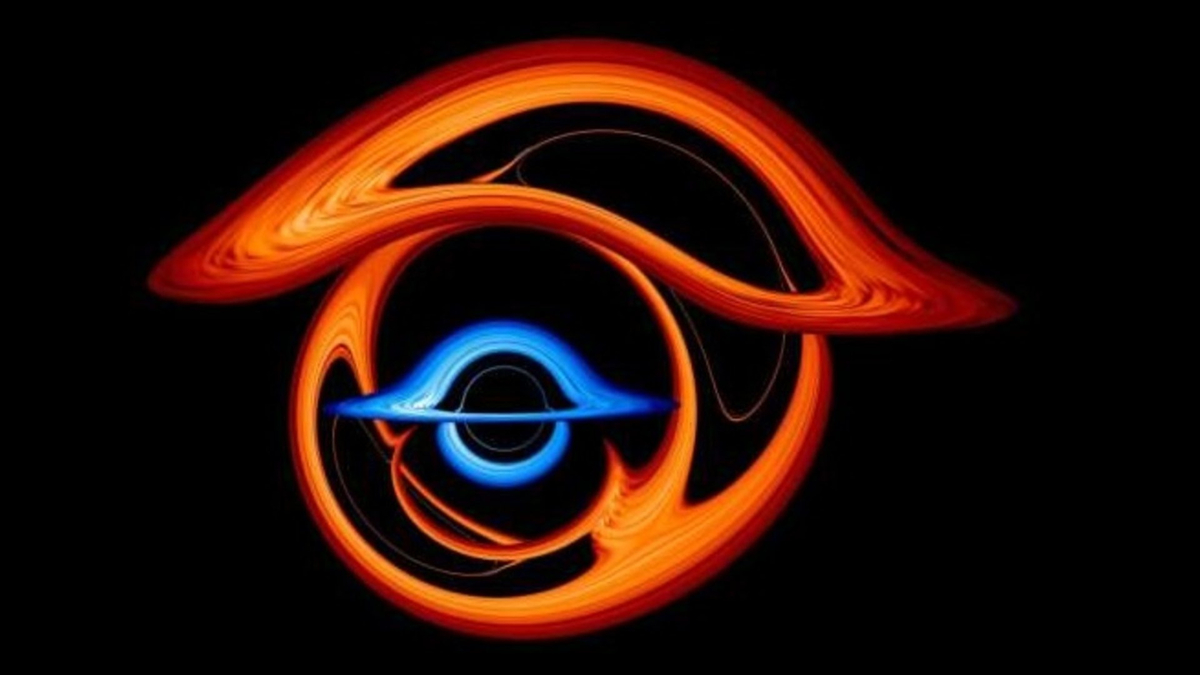
An international team, led by researcher Sizheng Ma of the Perimeter Institute, announced that it had detected for the first time the direct imprints of the event horizon during the merger of two black holes.
This event, called GW250114 and recorded in January 2025 by the LIGO observatory, produced gravitational waves of unprecedented clarity, making it possible to validate a century-old prediction by Albert Einstein.
What is the frame-dragging effect?
The observed phenomenon, known as frame-dragging (or Lense-Thirring effect), describes the way in which a rotating black hole distorts space-time around it.
Spacetime itself is whirled around by the colossal mass and rotation of the object. When two black holes merge, this whirlwind becomes cataclysmic.
As the two stars come closer in a spiral, ” the swirl gets stronger and stronger, and in the end, the orbital motion is basically dominated by this frame-dragging effect “, explique Sizheng Ma.
It is this final phase, the most violent, which emits a distinct gravitational wave signature. By capturing this signal, scientists were able to “touch” this strong gravity environment, ” a highly distorted region of space-time “.
How was this detection made possible?
If the first detection of gravitational waves in 2016 marked a turning point, the GW250114 event benefited from ten years of technological advances. These significantly reduced the background noise of the signals.
The black holes involved were similar to those in 2016, located around 1.3 billion light years away and between 30 and 40 times the mass of our Sun, and the clarity of the detection allowed theoretical models to be compared with real data.
The perfect match between the theoretical prediction and the observed signal provided a spectacular new confirmation of the theory of Einstein’s general relativity.
What are the implications for the physics of tomorrow?
Beyond confirming Einstein’s theories, this discovery provides scientists with a new tool to probe the most extreme regions of the Universe. The developed method makes it possible to isolate information from areas closer to the event horizon than ever before.
The ultimate goal is to detect possible flaws in general relativity, which could pave the way for new physics, including a theory unifying gravity and quantum mechanics.
In the future, the team hopes to detect signs of quantum fluctuations near the event horizon.
N.B. : Source images : Nasa (vignette) / Simulating eXtreme Spacetimes.


