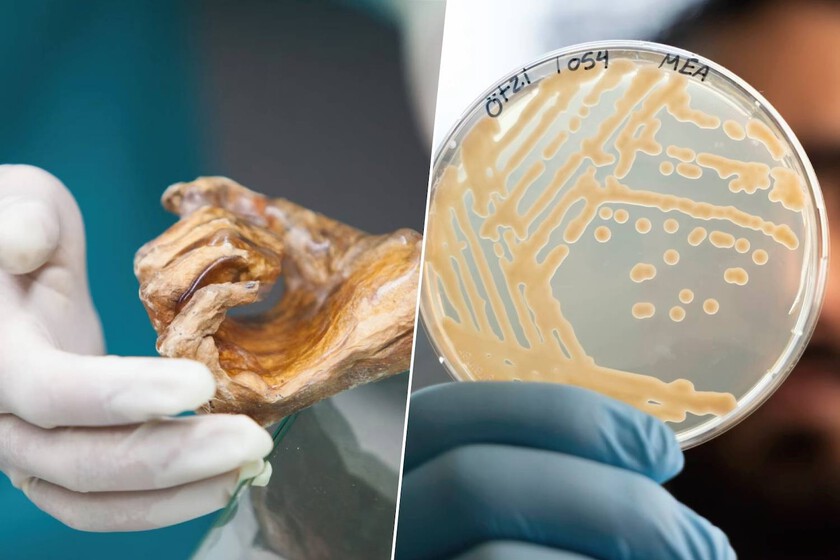
In 1991, two German hikers came across a body in the middle of the Alps, more specifically in the Ötztal Alps. At first they thought it would be a recent body, but nothing could be further from the truth: Ötzi, who takes his name from the place where he was found, died around 3255 BC. C. at approximately forty-six years of age due to hemorrhage caused by an arrow lodged in his left shoulder. Ötzi withstood the test of time thanks to glacial ice, becoming the oldest known natural human mummy in Europe.
For science, the “iceman” has historically been a magnificent biological and archaeological record of the late Neolithic/Copper Age, bridging the gap, like someone who finds a painting in a cave. But a recent study makes science look at it with different eyes: they have found life in Ötzi because the iceman is also an ecosystem.
There is life within Ötzi. The Eurac Research research team has found yeast strains that could have been dormant for millennia, some of which are still metabolically active as they are especially adapted to the cold: Glaciozyma, Goffeauzyma, Mrakia and Phenoliferia. That is, living organisms have survived inside a human body for more than five thousand years. They also found anaerobic intestinal bacteria such as Romboutsia hominis, Clostridium moniliforme and Ruminococcus bromii, which when the Iceman was alive helped him digest elements of his diet at that time.
Why is it important. The relevance of this discovery is enormous for both biology and archaeology, with implications that also point to space exploration:
- Biologically it is a real milestone: it is a before and after in what we know and can expect from microorganisms and their resistance. If microbes survive 5,300 years in alpine ice, they could potentially survive in similar inhospitable environments outside of Earth, such as the Moon’s south pole. And this has direct consequences for the search for extraterrestrial life.
- From an archaeological point of view, if a mummy contains microbial life inside, we must rethink how similar samples and other archaeological remains are preserved, stored and studied so as not to lose or degrade that valuable information.
What the finding says about health before antibiotics. Some gut bacteria found in Ötzi are still present in modern humans, but others have disappeared from modern Western populations. Being able to compare your microbiome with ours allows you to have a photo of what the microbiota was like before antibiotics, ultra-processed foods and industrial agriculture and apply it to medicine.
As science has already shown, the loss of this ancestral microbial diversity is associated with diseases such as Crohn’s or ulcerative colitis. In fact, Ötzi’s microbiome constitutes a good basis for designing more effective probiotics or improving fecal microbiota transplant therapies.
How have they done it. Ötzi is available for visits at the South Tyrolean Archeology Museum in Bolzano, Italy, where he is kept in a cold room at -6°C and 99% relative humidity. After more than 30 years of studies, science has paradoxically introduced modern microbes into his body, so it was essential to use multiple samples and methods to differentiate which microorganisms were already present during Ötzi’s life and which colonized him later.
From there, they combined genomic sequencing with laboratory culture and comparison with global databases, which for example allowed them to determine that the Methylobacterium and Sphingomonas bacteria found on the surface were introduced by modern humans, while Staphylococcus belonged to Ötzi’s original microbiome.
Yes, but. The main limitation of the study is precisely contamination: handling a mummy exposes it to potential contamination by modern bacteria and fungi, which complicates the faithful reconstruction of its original microbial composition. On the other hand, the fact that a yeast shows activity in the laboratory does not prove that it has been active continuously for 5,300 years, since it could have been reactivated when the experimental conditions changed. To clear up doubts, more independent studies with other glacier mummies are necessary.
In | In the 14th century, the “Little Ice Age” caught Europe completely off guard: this is how they managed to withstand the cold
In | Getting up at 3:52 AM, putting your face in ice, rubbing a banana: the male “morning routine” taken to the extreme
Cover | Museum of South Tyrol Archaeology, Eurac Research, Marion Lafogler and Andrea De Giovanni