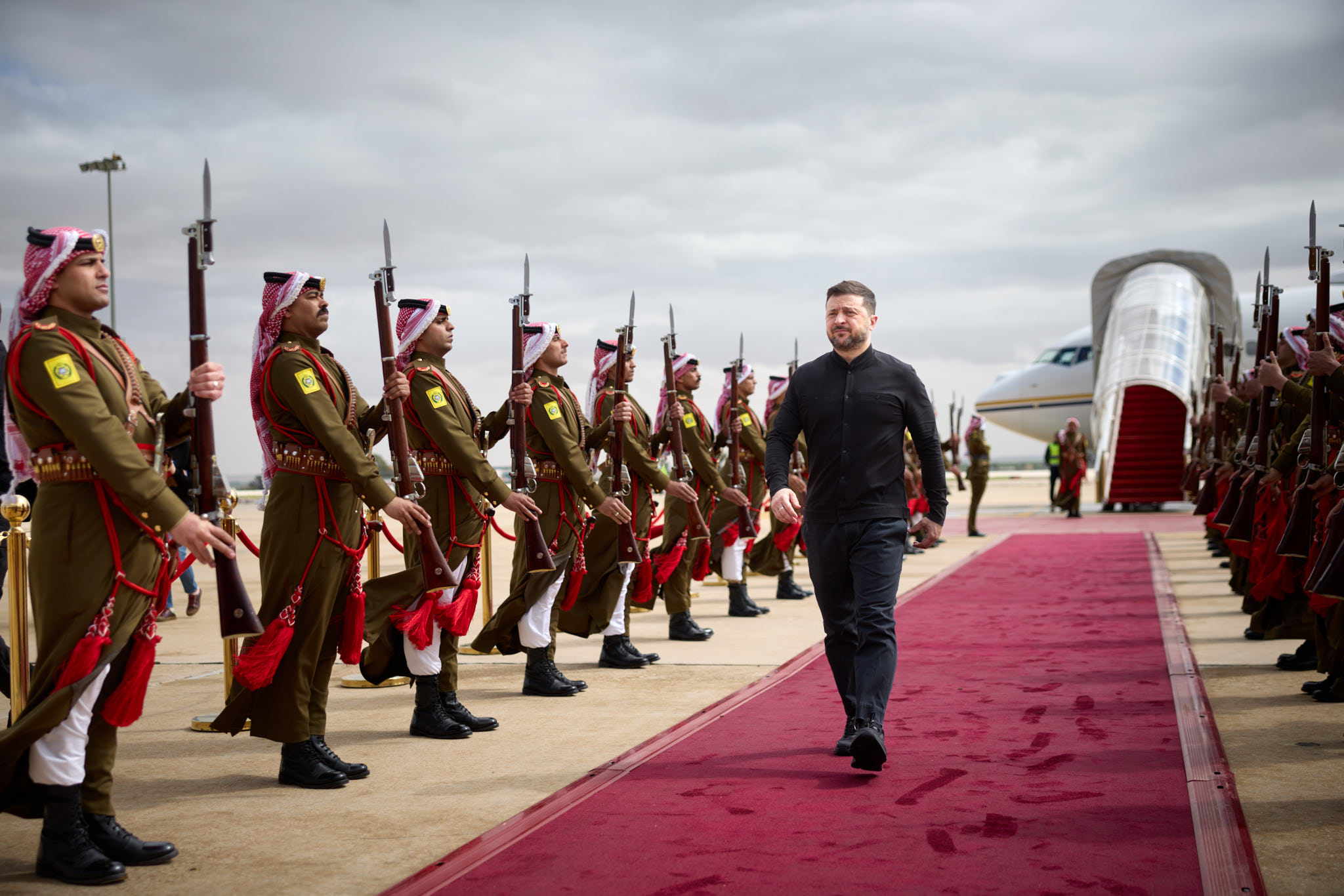
Ukrainian President Volodymyr Zelenskyy was given the red carpet treatment in Damascus last weekend as his diplomatic tour of the Middle East continued. The Ukrainian leader has also recently visited a host of Gulf states to discuss deepening security cooperation as countries across the region seek to access Ukraine’s unrivaled expertise in drone warfare.
Since the start of the US-Israeli war against Iran just over a month ago, Gulf leaders have turned to Kyiv as they look to address the threat posed by Iranian drones. By the middle of March, Ukraine had already reportedly deployed teams of specialists to five Middle Eastern countries to strengthen air defenses. Zelenskyy then arrived in person to ink a series of long-term security partnerships with Saudi Arabia, Qatar, and the United Arab Emirates. These unprecedented agreements have highlighted wartime Ukraine’s remarkable transformation from aid recipient to security provider.
The Gulf states are not alone in recognizing that Ukraine has moved beyond its earlier dependence on partner countries to become an increasingly important military power in its own right. Multiple NATO countries are also currently looking to learn from Kyiv’s unique experience of modern warfare. Germany recently became the latest NATO member to seek help from Ukrainian trainers as the country prepares for a possible future confrontation with the Kremlin. Berlin and Kyiv agreed in February 2026 that Ukraine would send military instructors to German army schools to share lessons they have learned during Russia’s invasion.
The growing demand for Ukrainian trainers within the NATO alliance is hardly surprising. During a series of military exercises over the past year, small Ukrainian drone units have repeatedly embarrassed far larger NATO contingents on land and at sea. This is helping to fuel an urgent debate over the changing nature of modern warfare, while raising awareness of the need for radically revised military doctrines that acknowledge the dominant role of drones.
Nobody understands the changing battlefield better than Ukraine. Since the start of Russia’s full-scale invasion in 2022, the Ukrainian authorities have turned to drone technologies as a cost-effective and sustainable solution to counter the Kremlin’s often overwhelming advantages in terms of manpower and conventional firepower. With Western military aid frequently delayed or insufficient, domestically developed drones have made it possible for Ukraine to stem the tide of Russia’s invasion and strike back in spectacular fashion.
Ukrainian drones are now ubiquitous above the battlefield, accounting for the vast majority of Russian casualties and creating a kill zone many kilometers deep that has transformed the front lines of the war into a vast gray zone where large-scale offensive operations are extremely challenging. In the Black Sea, Ukraine has used naval drones to break the Russian blockade of the country’s ports, sinking or damaging dozens of warships and forcing Putin to withdraw the remainder of his fleet away from occupied Crimea.
Meanwhile, Ukrainian drone technologies have allowed Kyiv to bring Putin’s invasion home to the Russian Federation with an increasingly effective campaign of long-range strikes against military and industrial targets deep inside Russia. In recent weeks, a series of Ukrainian drone attacks on Russia’s economically vital Baltic Sea port terminals succeeded in significantly reducing the country’s oil export capacity, depriving the Kremlin war machine of precious income.
Ukraine has also incorporated drone capabilities into the country’s complex air defense ecosystem. With Russia now launching hundreds of kamikaze drones at Ukrainian cities on a daily basis, Ukrainian drone manufacturers have developed a range of cheap but effective interceptor drones that are ideally suited to the challenges of large-scale attacks. This is the technology that Middle Eastern nations are now clamoring to acquire as they seek ways to defend themselves against Iranian drones without depleting limited supplies of expensive interceptor missiles.
Eurasia Center events

Ukraine’s emergence as a world leader in drone warfare is only one aspect of the country’s rapid rise to military prominence. Four years since the start of Russia’s full-scale invasion, the Ukrainian army is now by far the largest in Europe and has gained unrivaled experience of modern warfare that places the country at the cutting edge of military thinking. From drones and robotic systems to electronic warfare and cyber security, Ukraine’s military has earned an impressive reputation in a very short space of time.
Beyond the battlefield, Ukraine’s domestic defense industry has expanded exponentially since 2022 to become a valuable source of defense tech innovation that is attracting international attention. Growing numbers of foreign defense companies are establishing a presence in Ukraine, with investor interest also increasing. Many partner countries are now directly funding Ukrainian defense sector output as part of ongoing support programs.
International partnership initiatives are making it possible for Ukrainian companies to establish production facilities and joint ventures in allied countries including Britain, Germany, and Romania. Ukraine’s recent announcement of a relaxation on restrictions governing defense sector exports, if implemented properly, should facilitate the integration of Ukrainian companies into the European defense industry.
All this is very bad news for Russia. When Vladimir Putin launched the full-scale invasion of Ukraine in February 2022, he vowed to “demilitarize” the country. He has clearly failed to achieve this goal. Quite the opposite, in fact. Ukraine now boasts Europe’s most formidable fighting force along with a turbo-charged defense industry. Meanwhile, Ukrainian military specialists are guarding the Gulf region and training NATO. In other words, Putin’s fateful decision to invade has backfired disastrously and created the militarized Ukraine of his worst nightmares.
For Europe, Ukraine’s militarization could not have come at a better time. European leaders currently find themselves caught in a perfect storm of insecurity as they confront an expansionist Russia and a United States administration that seeks to scale back the country’s traditional role as Europe’s protector. With decades of defense sector neglect to overcome, European security now hinges on the ability of the Ukrainian army to keep Russia at bay until the continent can rearm.
As the world moves into a new and unpredictable multipolar era, Ukraine is emerging as a key contributor to the defense of Europe and an attractive security partner for the wider international community. In military colleges and defense ministries across the globe, Ukrainian expertise is now highly prized, while “Made in Ukraine” is increasingly recognized as a stamp of quality.
On the eve of Russia’s invasion, most international experts believed Ukraine would fall in a matter of days. It is now apparent that like Putin, they were guilty of gravely underestimating the Ukrainian nation. Four years on, it is time for a reality check. Today’s Ukraine has been forged in the crucible of Europe’s largest war since World War II and is now a military force to be reckoned with. This is already reshaping Europe’s security architecture and looks set to have a significant impact on the broader geopolitical balance of power for many years to come.
Peter Dickinson is editor of the ’s UkraineAlert service.
The views expressed in UkraineAlert are solely those of the authors and do not necessarily reflect the views of the , its staff, or its supporters.

The Eurasia Center’s mission is to enhance transatlantic cooperation in promoting stability, democratic values, and prosperity in Eurasia, from Eastern Europe and Turkey in the West to the Caucasus, Russia, and Central Asia in the East.
Image: Photo credit: © Press Service Of The President Of Ukraine / YPV.2026