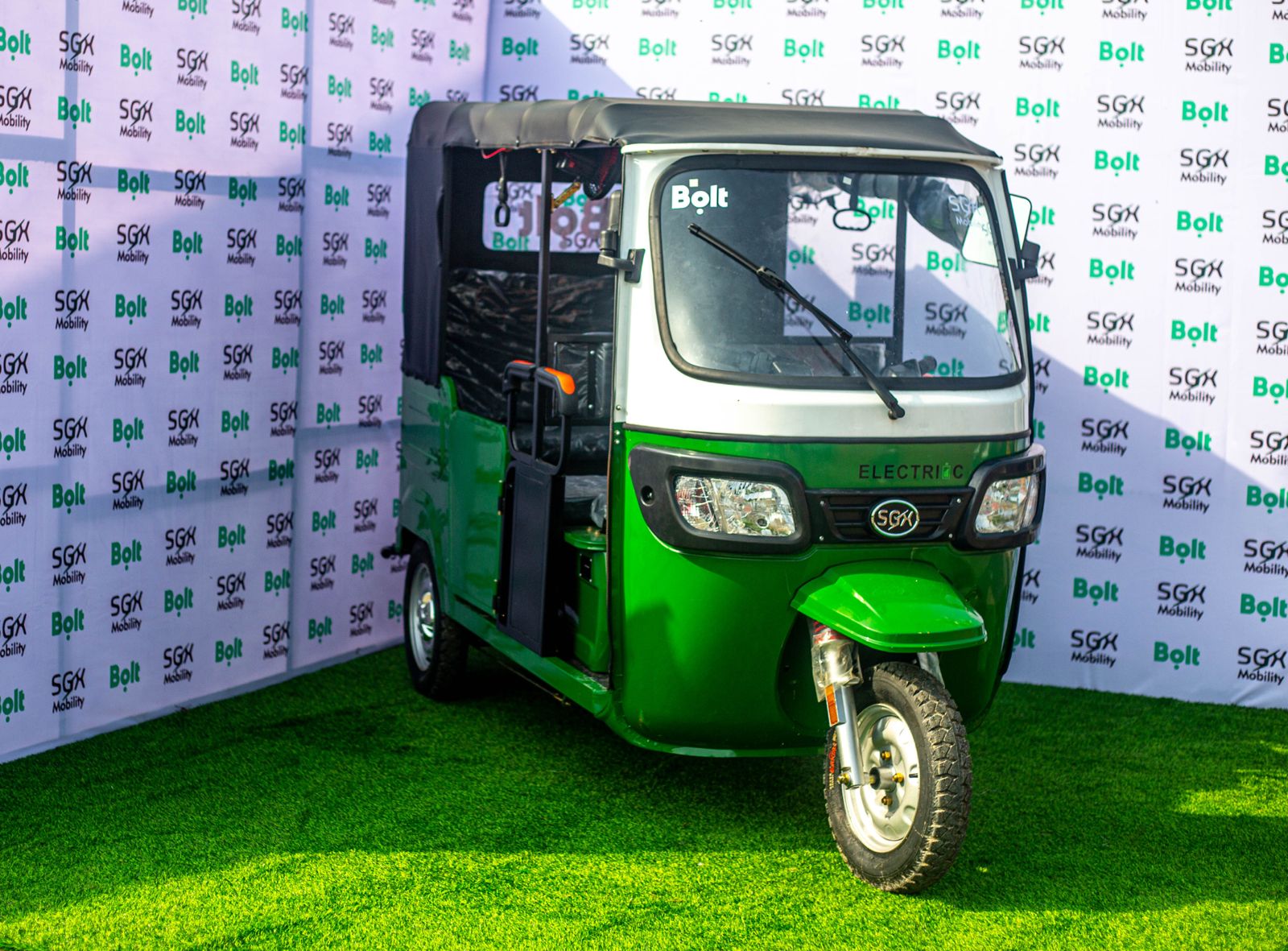
The first thing that stands out with Bolt’s three-wheelers is the colour.
In Lagos, where tricycles, popularly called ‘keke,’ are uniformly yellow and rounded, Bolt’s tricycle arrives in green and is noticeably square. In a swarm of Lagos tricycles, it is the one you spot immediately because it refuses to blend in.
The door is the second surprise. Tricycles in Lagos are open on the sides, allowing passengers to step in and out at will, half exposed to wind and rain. This tricycle has a short door panel that closes firmly enough to create a boundary between the rider and the street.
If the exterior of this three-wheeler does not fully separate it from the yellow tricycles on Lagos roads, the interior does. Behind the driver’s seat are two benches that face each other, with riders seated, knees touching. A small fan is mounted on the roof, next to a folded transparent tarp that can be pulled down in heavy rain.
Then, there is the sound, or absence of. The typical petrol-powered tricycles vibrate with combustion noise, compared to the electric tricycle’s soft hum.
Bolt introduced the electric tricycle in Lagos in April 2025 to expand its electric vehicle (EV) footprint across West Africa and test how the three-wheelers could work within the city’s transport system.
According to the company, the decision to introduce tricycles was rooted in how people actually move across many urban areas in the country. In some of Nigeria’s urban cities, tricycles are an affordable way to navigate road networks that cars can struggle with, and have become an essential part of transportation for commuters.
“For us, mobility solutions have to be locally relevant. That’s why we began by integrating a transport mode that already exists and plays a significant role in local economies,” Weyinmi Aghadiuno, Head of Regulatory & Policy Africa at Bolt, told . “Tricycles allow us to expand access to affordable mobility for riders while also creating earning opportunities for drivers.”
A trip constrained to a radius
On the Bolt app, Bolt Keke appears as a separate category along with other options like Bolt Comfort, Bolt Priority, and Bolt Motorbike for parcel delivery, but only in select areas of Lagos: Gbagada and Bariga. This geographical limitation is defined by its battery-powered nature.
Unlike petrol vehicles, Bolt’s EVs cannot be refuelled on the go when the battery runs down; riders must return to a designated swap station in Surulere, a busy commercial and residential neighbourhood in mainland Lagos.
For Oluwaseun, who has driven a Bolt tricycle since November 2025, that means at least three swaps across roughly 20 trips a day, each one a calculation of how far a charged battery will carry him before he needs to turn back.
Ordering the electric tricycle works like any other ride on the app. A passenger selects a pickup point within the tricycle’s operational radius, enters a destination, and selects the tricycle category, which displays a fare estimate before confirming.
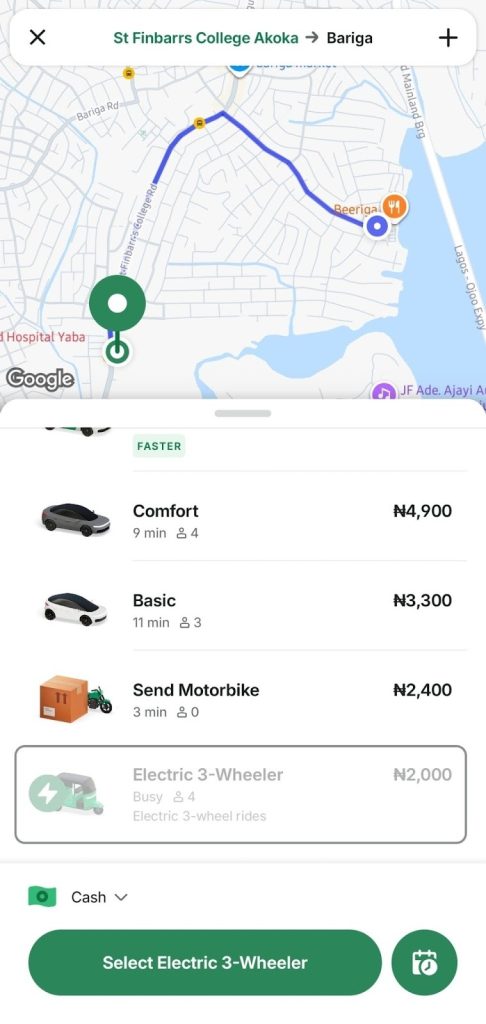
In pricing, the tricycle category sits below standard cab options. In the 1.8km trip above, the cost of Bolt’s three-wheeler sat at ₦2,000 ($1.47), while other options, such as Comfort and Basic, went for ₦4,900 ($3.60) and ₦3,300 ($2.42), respectively.
Unlike the regular street-side tricycles, where passengers often share rides with others heading in the same direction, Bolt’s tricycle rides are private trips ordered through the app.
Passengers who would want the street-side tricycles to themselves must negotiate a drop-off fare with the driver so no other passengers are picked up along the way. On Bolt’s tricycles, that negotiation is replaced with a price displayed upfront within the app.
“I use Bolt [tricycle] often,” Progress Oghenerume, a user in Uyo, the capital city of Akwa Ibom State in Nigeria’s southern region, said. “If I am taking a drop-off, I have a predetermined price, so I know how much it is going to cost, than when I have to haggle with the one I stop on the road.”
Eberechukwu, a Lagos-based user, shared this sentiment. “I used it once to carry things I bought from Bariga market. It was easier than going back and forth about prices with regular keke drivers.”
The first tricycle experiment
Bolt first introduced the tricycle category in Uyo in January 2020. Those three-wheelers run on petrol and are painted in a bold red hue.
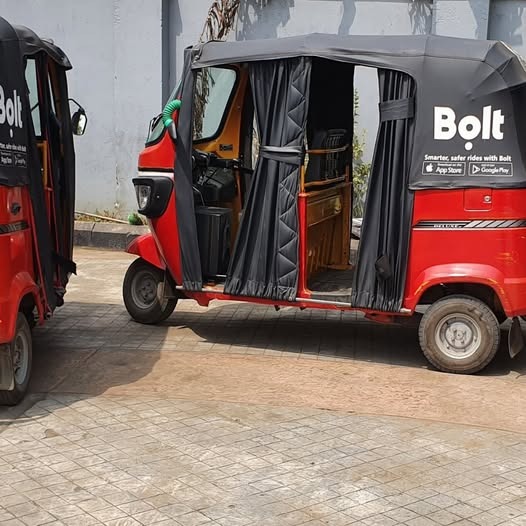
A few months later, Bolt expanded the category to Enugu. Unlike Lagos, where the electric version operates within defined zones, the petrol tricycles in Uyo and Enugu are more ubiquitous and woven into everyday transportation across the cities.
“The adoption of the tricycle category in Nigeria has been very encouraging. In several cities, particularly places like Uyo and Jos, the category has quickly become one of the most popular options on the platform for both riders and drivers,” Aghadiuno added.
Bolt said the electric version in Lagos represents a newer phase of the model, built on lessons learnt from testing the model in other African markets, including Kenya.
“Those experiences showed us that lighter electric vehicles can work very well in African cities where operating costs and fuel prices are major concerns,” Aghadiuno said.
Bolt’s Lagos rollout began with a pilot of 20 electric tricycles to test rider demand and operational logistics. Since then, the company has said the number of active electric tricycles on the platform has more than doubled.
Bolt is not the first ride-hailing platform to experiment with alternative vehicle categories in Nigeria. In 2017, Matatu, a local ride-hailing platform for tricycles, launched in Lagos with an exclusive agreement with the Tricycle Owners and Operators Association of Nigeria (TOOAN).
At the time, the startup had onboarded more than 500 drivers with over 3,500 riders signed up on its platform. The service was only available in specific areas of Lagos Island; however, the startup has disappeared quietly.
MAX.ng, an electric mobility financing startup, also hinted at operating a tricycle category in 2019, but eventually pivoted to focus on electric motorbikes. Major global platforms such as Uber and inDrive do not currently offer electric tricycle categories; however, Uber launched a two-wheeler service, UberMoto, in Ibadan in 2022.
Bolt said its approach to new mobility categories is deliberately incremental. “Our approach with new mobility solutions is to start small, learn quickly and scale responsibly,” Aghadiuno added.
The three-wheeler segment serves routes that are too short or too narrow for cars, and gives Bolt a first-mover advantage over its global competitors. Bolt’s electric vehicle play in a country where petrol prices have become volatile offers stability for drivers and cheaper ways to move around for riders.
As Bolt’s electric tricycles currently operate within a limited radius in Lagos, the company said the early results from the pilot have been promising, and it is evaluating opportunities to expand the deployment across additional areas of the city.
“Ultimately, this initiative is about more than introducing a new vehicle type. It is about building a future where mobility is more affordable, accessible, and environmentally sustainable for African cities,” Aghadiuno concluded.