The fact that 90% of the world’s population being right-handed is a riddle that science has been trying to solve for a long time. A team of researchers from theUniversity of Oxfordled by Dr. Thomas A. Püschel and published in the journal PLOS Biologyprovides new elements of response.
By analyzing data from more than 2,000 individuals across 41 species of monkeys and great apes, they identified the evolutionary cocktail that seems to have sealed our manual fate: the biped and a larger brain.
Why is this right-handed thing such an evolving puzzle?
The preference for the right hand A wise man is extraordinarily strong and consistent compared to all other species. About 90% of humans are right-handed.
It is a constant that crosses cultures and ages, a trait so common that we forget its fundamental strangeness. Indeed, no other of our cousins primates does not show such a trend at the scale of an entire population.
With them, manual preferences are often weaker and variablesometimes linked to a specific task but never so generalized.
This near human unanimity was therefore a grain of sand in the great clock of evolution. Scientists have explored everything: the use of tools, genetics, the asymmetrical structure of the brain.
But none of these theories alone was able to explain why this preference was so massive and so specific to our lineage. Humans remained a statistical anomaly, a special case that seemed to defy global explanatory models of primate evolution.
What is the new theory that links walking and the brain?
The new explanation offers a two-act scenario in which bipedalism and brain size are the main players. The Oxford study demonstrated that if we take into account the walk on two legs (evaluated by the ratio between the length of the arms and the legs) and the brain growth (encephalization) in evolutionary models, humans cease to be an exception.
He fits in perfectly. In other words, our preference for the right hand is a direct consequence of these two traits that define us.

The first act is therefore the passage to the biped. By freeing our hands from the burden of locomotion, this step created a selection pressure unprecedented for increasingly complex and precise manual tasks.
The second act, which occurred later, is the increase in brain sizewhich made it possible to “wire” this specialization, favoring one hemisphere (the leftwhich controls the right hand) for fine motor tasks, and thus reinforcing the right-handed tendency to the point of making it almost universal.
How did our ancestors gradually become right-handed?
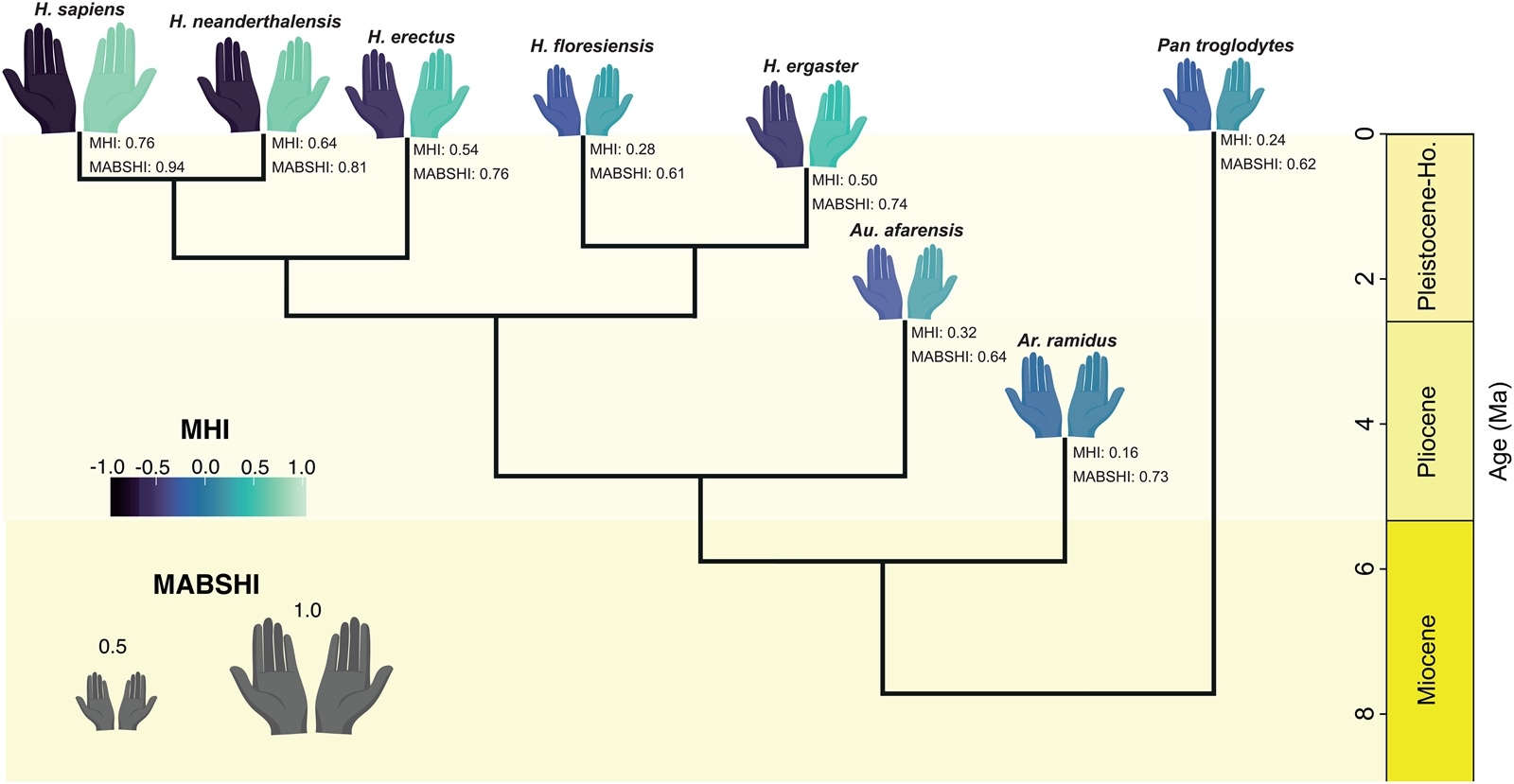
The models in the study allow us to go back in time and trace a picture of this evolution. Early hominids like Ardipithecus or the Australopithecines (the famous Lucy) probably only had one low preference for the right hand, quite similar to that of current great apes.
The trend began to gain significant strength with the emergence of the genre Homoin species like The man stood up and the Neanderthals, to reach its peak with us, A wise man.
Credit : PLOS Biology
This new chronology ofhuman evolution shows a gradual increase in power. There is, however, one notable exception which confirms the rule: Homo floresiensisthe “hobbit” of Indonesia.
This species, with a small brain and adaptations for climbing, shows a right-handed preference predicted as much weaker. This fits the model perfectly: without exclusive bipedalism and a large brain, the pressure for extreme manual lateralization was much less.
What questions does this discovery leave unanswered?
This study provides an elegant answer to “why,” but several mysteries remain. The biggest enigma is the persistence of left-handers. If the evolutionary pressure was so strong, why about 10% Has the population retained this characteristic?
Some scientists put forward hypotheses linked to strategic advantages in combat or sport, but the debate remains open.
Another exciting area of research concerns the role of culture cumulative. To what extent have traditions, education and the manufacture of standardized tools amplified and stabilized this right-handed preference over the millennia?
Finally, researchers are wondering about cases of “lateralization” in other animals, such as kangaroos or parrots, to see if any similar evolutionary pressures (related to posture or handling) could be at work.