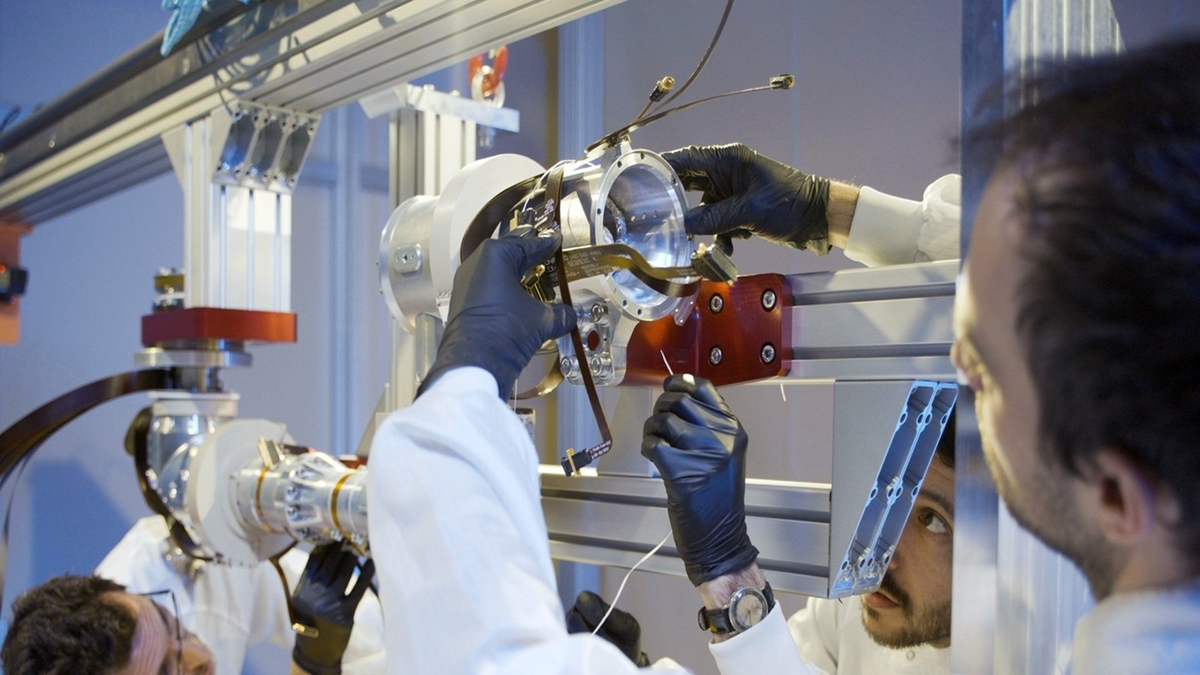
The Sample Transfer Arm (STA) is an advanced 2.4 meter robotic arm, developed by theESA (European Space Agency) and an industrial consortium led by the Italian firm Leonardo.
Equipped with seven degrees of freedom, cameras, and sensors giving it a form of “touch”, it is designed to handle samples with millimeter precision and operate autonomously on the Moon and Mars.
Faced with the uncertainties of NASA’s Mars Sample Return project, ESA is repositioning it as a multi-purpose tool for future lunar bases and distant manned missions.
Why is this robotic arm so special?
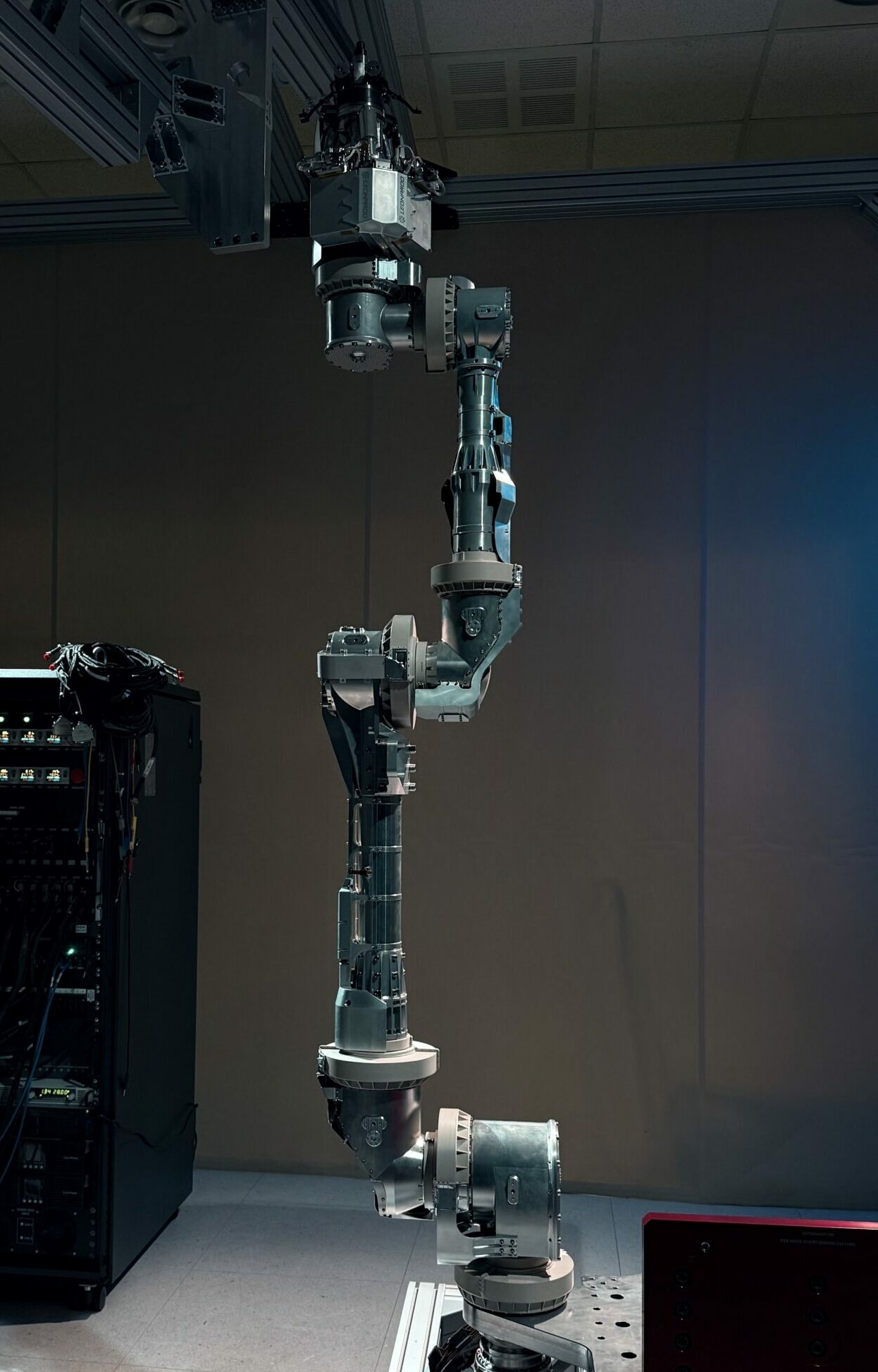
The strength of the STA lies in its mimicry with the human body. It has an architecture similar to our own arm, with a shoulder, an elbow and a wrist articulated.
Credit : Leonardo
This configuration offers him seven degrees of freedom which allow him to reach objects and perform gestures of incredible complexity. At the end of this arm is a pincer, a sort of “hand” capable of grasping geological samples or tools with a millimeter precision.
But the resemblance doesn’t stop at the mechanics. The STA is designed to perceive your environment and adapt accordingly. It introduces a degree of decision-making autonomy directly into the field.
How can the “Sample Transfer Arm” see and feel?
To achieve such a level of autonomy, the STA is equipped with an arsenal of sensors which constitute its senses. Of the cameras mounted directly on its structure act as its “eyes”, providing it with visual awareness of its surroundings.
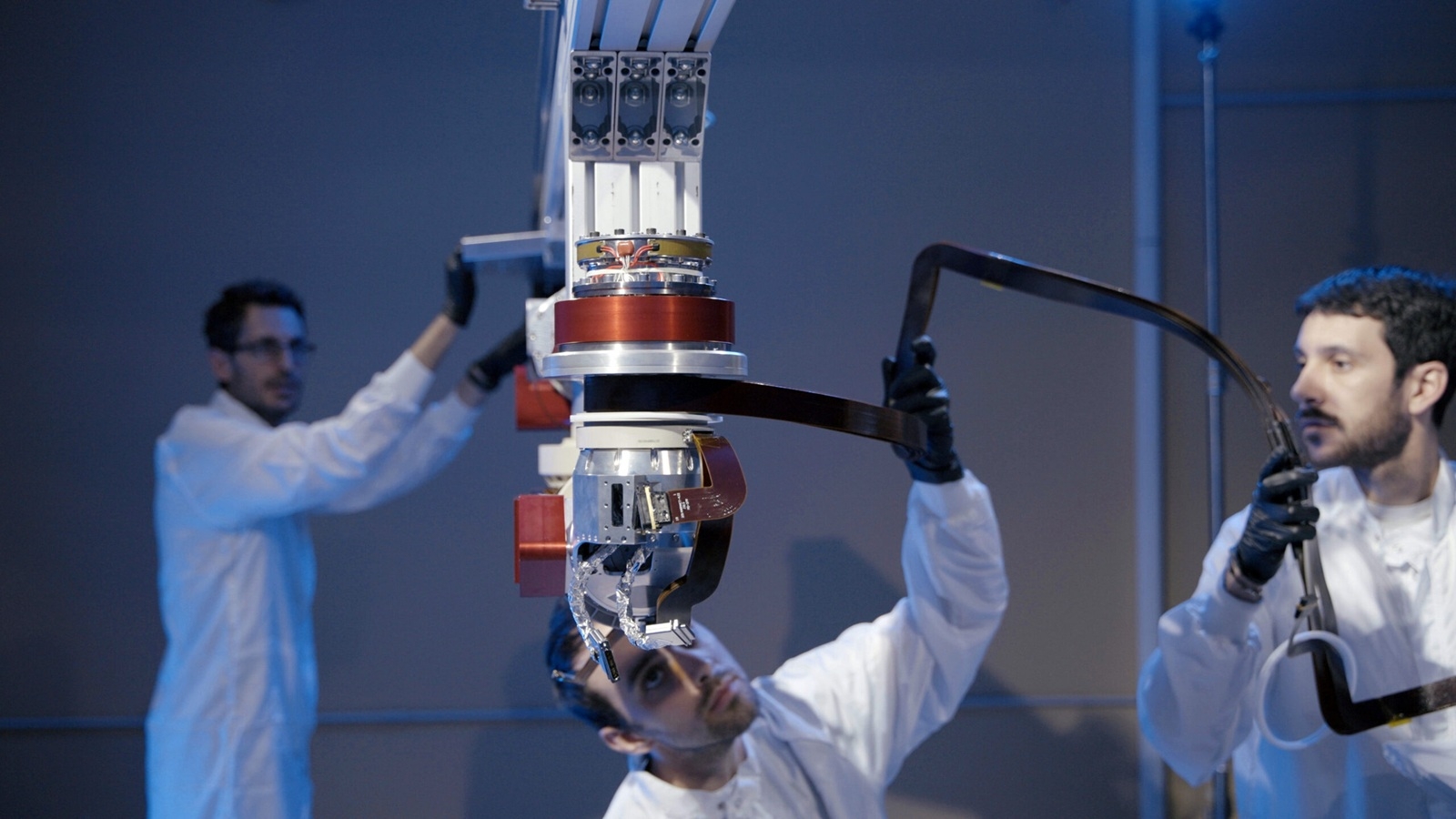
They allow it to detect, identify and interact with the objects around it. But perhaps his most impressive ability is his sense of touch. A force and torque sensor, measuring pushing, pulling and twisting forces, is integrated into its end.
Credit : Leonardo
This sensor allows the arm to “feel” the resistance of an object and adjust its force accordingly, avoiding breaking a fragile sample or mishandling equipment.
In addition, position sensors, housed in each joint, constantly calculate the exact location of the clamp. All of this data is processed by its electronic control unita real on-board “brain” which orchestrates its movements.
What is the initial and future mission of this robot?
Originally, the STA had a well-defined role: to be the key link in the mission Mars Sample Return. Its task was to recover the precious Martian sample tubes collected by the rover Perseverance of NASA and transfer them to the vehicle that would have brought them back to Earth.
However, with the future of this mission currently up in the air, the ESA has intelligently decided to capitalize on this technology for other projects. Its versatility makes it an ideal candidate forspace exploration lunar.
Credit : Leonardo / ESA / Human’s Point
The arm could assist astronauts, assemble structures, collect regolith samples or even maintain equipment on a future lunar base.
Its robust design, including mechanisms to withstand the violent vibrations of launch and landing, prepares it to face any hostile environment.
Who are the actors behind this European technological feat?
This project is the result of an ambitious European collaboration, led by ESA. The project manager is the Italian giant Leonardobut he leads a large industrial consortium.
Spanish companies like GMV and AVS provide expertise, while Switzerland (Maxon), France (3DPlus) and Romania (COMOTI) provide critical components. Danish, Greek and German suppliers complete this technological puzzle.
This cooperation illustrates Europe’s desire to develop a strategic autonomy in the field of space robotics. By mastering these technologies, Europe becomes a key player capable of carrying out its own exploration missions.