At companies xAI installed 19 new gas turbines on his website Colossus 2 in Mississippi, bringing the total to 46 units and more than 500 MW additional.
But this rise in power is triggering growing legal and environmental tensions.
The site, located in Southaven (Mississippi), is largely based on gas turbines to produce electricity locally, a quick but controversial solution.
Why is xAI installing so many gas turbines?
All these gas turbines immediately supply its colossal needs for computing power while the supply from the electricity network is not sufficient.
The new units add more than 500 MW, essential for running large-scale GPUs. Without this energy, drive systems grind to a halt.
But behind this technical logic lies an assumed strategy: producing on site to avoid the limits of the traditional electricity network. THE data center Modern technologies consume amounts of energy comparable to entire cities.
As a result, xAI is literally building its own power plant. An energy headlong rush that raises questions.
Is Colossus 2 really an extraordinary project?
L’infrastructure Colossus 2 aims to achieve capacities close to the gigawatt (1 billion watts), a threshold rarely seen for an AI cluster. The final objective mentioned by Elon Musk: 2 GW distributed over several sites.
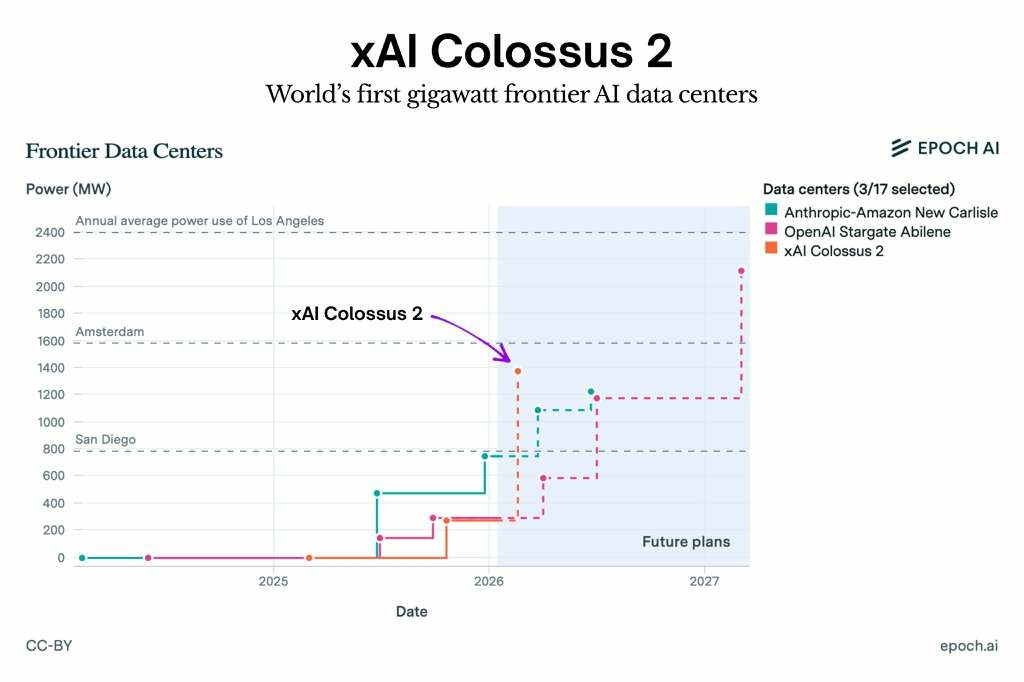
In practice, the first estimates show a gap between ambitions and reality. Cooling equipment suggests a much lower initial capacity.
But the race for data centers does not wait and it is a question of who will have the largest installations, with the prospect of a risk of China catching up within a few years.
Why are these installations problematic?
The heart of the conflict is legal and environmental. Several organizations accuse xAI d’operate turbines without a license compliant with Clean Air Act (United States Clean Air Act). Some installations would have been active before official validation.
THE gas turbines emit CO₂ and fine particles, which worries local residents, particularly in already vulnerable areas. In Memphis, similar criticism emerged around another site. Technological progress here comes up against a social reality.
What is the impact on the future of AI?
In the short term, these infrastructures provide a huge advantage. With his data centersxAI can train models faster and on a larger scale. This is crucial in the global AI race.
But in the long term, the energy question becomes central. AI now depends on heavy, energy-intensive infrastructures that are difficult to deploy properly, while waiting for new solutions such as micro and mini nuclear reactors which could be deployed directly on site.
A sustainable strategy or a dead end?
For now, Colossus 2 illustrates a pragmatic approach: produce quickly, even if it means optimizing later. “Temporary” turbines make it possible to circumvent certain regulatory constraints and delays that are detrimental to the company.
But this logic could reach its limits. Between regulatory pressure, local opposition and environmental cost, xAI will have to adjust its trajectory, under penalty of facing growing protests in view of the pollution generated by its installations.