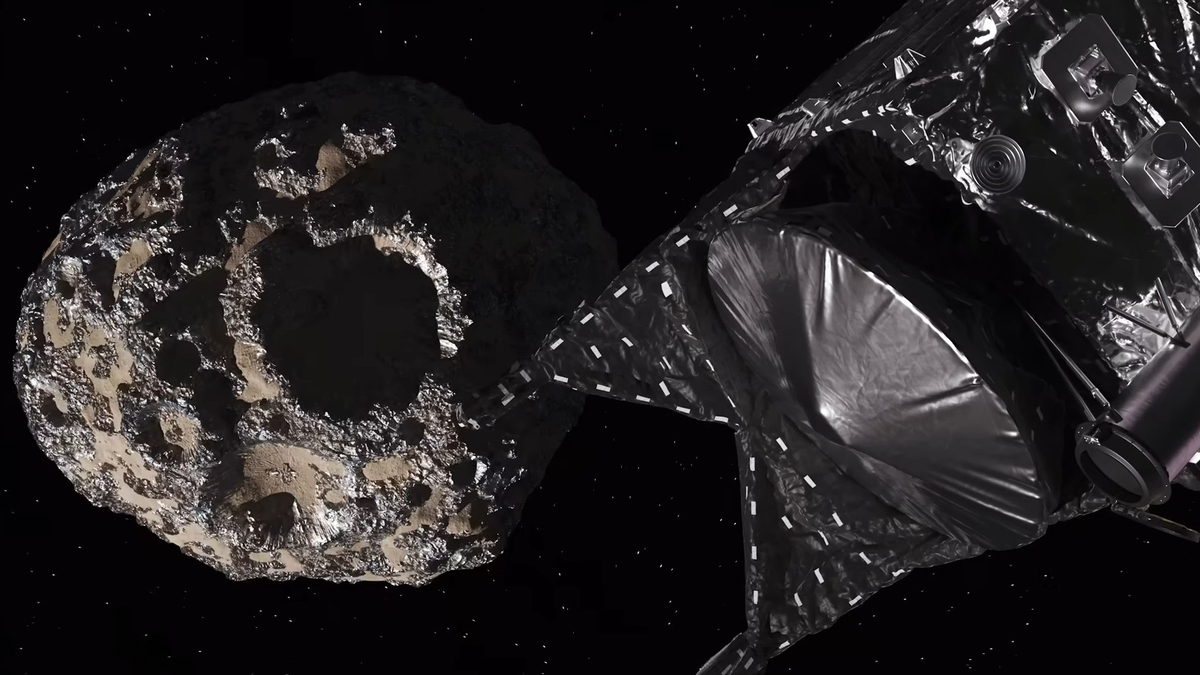
The space probe Psyche of NASA will use the planet Mars for a gravity assist maneuver next May 15. By grazing the Martian surface at just 4,500 kilometers, the gravity of the red planet will propel the probe, increasing its speed and adjusting its trajectory towards its final destination: the metallic asteroid (16) Psychewhich it will reach in 2029.
Launched in October 2023, the Psyche mission navigates thanks to solar electric propulsion, a system efficient but slow which uses xenon gas. For its long journey of several years, every gram of fuel counts.
This is where Mars comes into play. The scheduled flyby is a demonstration of economy and navigational intelligence: instead of burning tons of propellant, NASA engineers harness a fundamental force of the universe, the gravityto give their machine a monumental thrust.
Why does the Psyche probe need to brush past Mars?
The main reason for this overflight is a maneuver ofgravity assist (sometimes called “ slingshot effect “). This technique allows a spacecraft to use a planet’s gravity to change its speed and trajectory without consuming fuel.
For the Psyche probe, this “boost” from Mars is absolutely crucial. It will catapult it deeper into the solar system, towards the asteroid belt.
The probe borrows some of the planet’s orbital energy, which results in a significant acceleration. This spatial ingenuity transforms gravitational obstacles into stepping stones. Without this maneuver, the trip would be much longer and would require an amount of fuel that the probe simply cannot carry.
What will this Martian flyby look like for the probe?
The spectacle will not be that of a familiar glowing disk. The Psyche probe will approach the planet by its nocturnal sideto a “ high phase angle ».
Concretely, she will first see Mars as a fine crescent of lighta bit like our Moon just after the new moon. The light from the Sun, grazing, will be mainly reflected by the Martian atmosphere and its suspended dust, creating a delicate halo around the planet.

Scientists even expect unique observations. Jim Bell, the mission’s imager manager, explains that this overexposed crescent, then the sight of a ” almost full Mars » after the passage, offer extraordinary opportunities to calibrate the cameras.
The images could even reveal a fascinating detail: a possible gap in the bright crescent at the level of the northern polar cap, perhaps due to seasonal clouds blocking the diffusion of light by atmospheric dust.
What are the hidden scientific objectives of this maneuver?
If the primary objective is indeed propulsion, this flyby is an invaluable dress rehearsal. This is the first chance for the team to test and calibrate your instruments on a real planetary target before reaching the real objective, theasteroid Psyche.
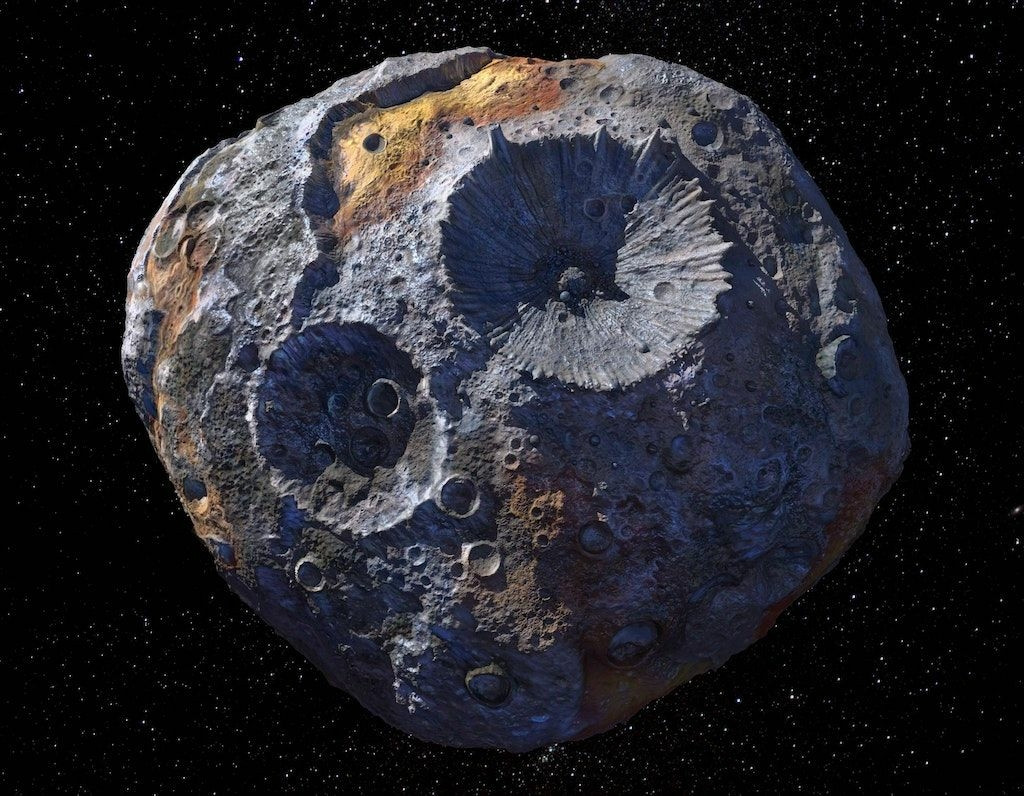
The multispectral camera will take thousands of shots to refine imaging techniques which will be vital in 2029. But that’s not all. Psyche’s instruments will transform into real detectives.
The imager will look for a hypothetical and very weak dust ring around Mars, potentially created by micrometeorite impacts on its moons, Phobos and Deimos.
The team will also carry out a “satellite search” to practice finding possible small moons around the asteroid Psyche.
How does NASA make sure everything goes according to plan?
Confirmation of the success of the maneuver will be almost instantaneous. Ground teams will follow radio signals from the probe via the Deep Space Network (DSN) from NASA.
Any variation in speed will result in a change in the frequency of the signal, a phenomenon known asDoppler effect (the same one that modifies the sound of an ambulance siren approaching then moving away).
This measurement will make it possible to calculate with formidable precision the new speed and new trajectory of Psyche. In addition, the probe will not be alone. A whole flotilla of machines already on site, such as orbiters MRO et Mars Express or the rovers Curiosity et Perseverancewill provide additional data.
This collaboration inter-missions will make it possible to cross-reference information, further improve the calibration of Psyche’s instruments and refine navigation models for future Martian missions.