This is the story of one of the longest and most thankless scientific hunts in modern physics. Since 2016, physicist Stephan Schlamminger, from National Institute of Standards and Technology (NIST) in the United States, locked himself in his laboratory for a mission: to measure “ Big G », the constant which determines the force of attraction between two masses.
The goal was to replicate a French experience to finally obtain a consensual value. Ten years later, the result is there…and it solves nothing, quite the contrary.
Because far from closing the debate, this result departs from previous measurements, including the experience it sought to replicate. The quest to precisely define the most fundamental force in the universe remains a puzzle.
Why is measuring gravity so complicated?
The main reason is that the force of gravityalthough omnipresent, is cosmically weak. It is by far the most discreet of the four fundamental forces of the universe. This intrinsic weakness makes its measurement in the laboratory extremely delicate.
In the laboratory, scientists must use relatively small masses, which therefore generate only tiny forces. The challenge then becomes to distinguish this tiny signal from the gravitational background noise generated by everything around us: the building, a truck passing in the street, and even the experimenter.
Isolating the intended interaction is a nightmare, transforming every measure of theuniversal attraction in a fight against invisible disturbances.
What is the new value of G and why is it disappointing?
The fateful figure revealed by the NIST team is 6.67387×10⁻¹¹ m³/kg/s². To the layman, this number doesn’t mean much. But for metrologists (scientists specializing in measurement), it’s a little bomb.
This value is in fact 0.0235% lower than that of the French experience which it was supposed to confirm. It’s a step forward that looks suspiciously like a step aside, leaving the scientific community in an even thicker fog regarding this famous gravitational constant.
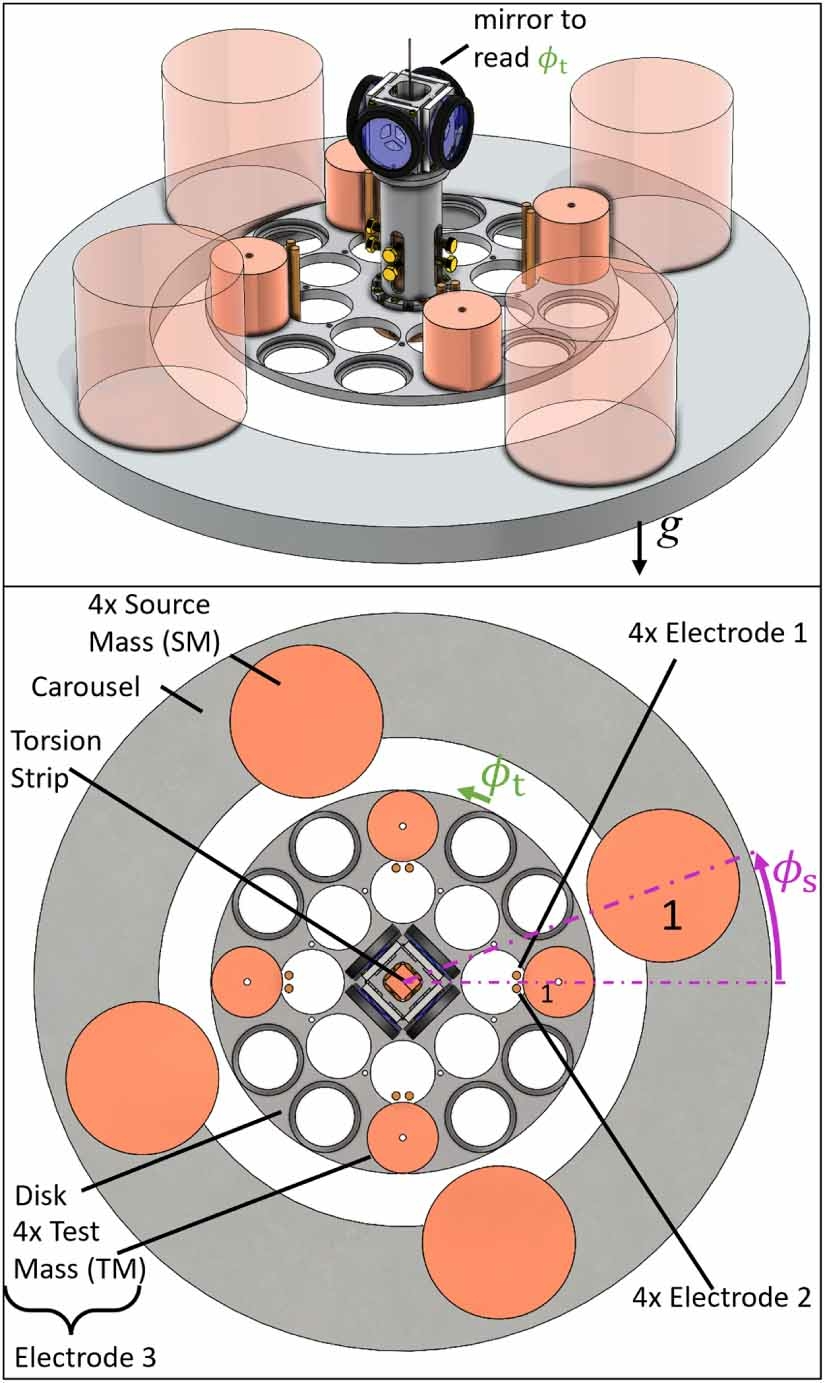
Credit: Schlamminger / IOPScience
The gap may seem tiny, but at this scale of precision it is huge. Schalamminger himself compares it to the fact of “ measure the height of a human being and be wrong by a millimeter or two ».
In the world of fundamental constants, where some are known to eight decimal places of precision, such uncertainty in the value of G is judged “ quite embarrassing “. The mystery, far from dissipating, thickens.
How did this experiment attempt to avoid the mistakes of the past?
Aware of the pitfalls, Schlamminger has implemented an absolutely rigorous protocol to protect himself from the researcher’s greatest enemy: through the experimenter.
To avoid being unconsciously influenced by the expected results, he asked an external colleague to add a random value to the masses used. The code to decipher this modification has been sealed in a secret envelopewhich Schlamminger only opened at the very end of his scientific experience.
This method, called “blind”, guarantees total objectivity of the measurements. Yet even with this precaution, the end result was a surprise. The protocolas rigorous as it was, was not enough to tame G’s elusive nature.
Should you throw everything away? What is the future of this quest?
Far from being an assessment of failure, this result is a wonderful lesson in humility and rigor. The team identified several previously overlooked intrinsic effects, such as the influence of residual gas pressure in the vacuum chamber.
The goal was not just to find a number, but to track down the unknown, to expose the flaws in our methods. Science often advances not by finding answers, but by asking better questions. This is the very nature of research into the mystery of gravity.
Stephan Schlamminger does not consider these ten years wasted. His passion remains intact, to the point that he carries the Planck constant, which he helped to fix in 2019, tattooed on the forearm. But he admits he would never get the value of G tattooed on him.
The reason? The number is good too capricious “. An admission that perfectly sums up the challenge that this fundamental constant continues to pose questions to the greatest minds of our time.