By using this site, you agree to the Privacy Policy and Terms of Use.
Accept
World of SoftwareWorld of SoftwareWorld of Software
  • News
  • Software
  • Mobile
  • Computing
  • Gaming
  • Videos
  • More
    • Gadget
    • Web Stories
    • Trending
    • Press Release
Search
  • Privacy
  • Terms
  • Advertise
  • Contact
Copyright © All Rights Reserved. World of Software.
Reading: Privacy Guardrail: Chrome extension wants to protect sensitive data from chatbots
Share
Sign In
Notification Show More
Font ResizerAa
World of SoftwareWorld of Software
Font ResizerAa
  • Software
  • Mobile
  • Computing
  • Gadget
  • Gaming
  • Videos
Search
  • News
  • Software
  • Mobile
  • Computing
  • Gaming
  • Videos
  • More
    • Gadget
    • Web Stories
    • Trending
    • Press Release
Have an existing account? Sign In
Follow US
  • Privacy
  • Terms
  • Advertise
  • Contact
Copyright © All Rights Reserved. World of Software.
World of Software > Software > Privacy Guardrail: Chrome extension wants to protect sensitive data from chatbots
Software

Privacy Guardrail: Chrome extension wants to protect sensitive data from chatbots

News Room
Last updated: 2026/05/21 at 7:21 PM
News Room Published 21 May 2026
Share
Privacy Guardrail: Chrome extension wants to protect sensitive data from chatbots
SHARE

  1. Privacy Guardrail: Chrome extension wants to protect sensitive data from chatbots

Anyone who wants to protect personal data from being inserted into AI chat services can use a new extension for Chromium-based web browsers such as Google Chrome. It’s called Privacy Guardrail and comes from the German Research Center for Artificial Intelligence (DFKI) and the RPTU Kaiserslautern-Landau. The extension is intended to recognize and anonymize personal data locally in the browser. Privacy Guardrail is currently in public beta testing (version 0.2.0).

Read more after the ad

Placeholders instead of plain data

When pasting text, the extension intercepts the clipboard paste event and parses the content locally. The system then replaces information that is recognized as worthy of protection – before it is sent to the AI ​​service. In the settings, users can choose between two replacement modes: either sensitive areas are replaced with typed placeholders such as (EMAIL_1) or (PERSON_1) replaced, or the system uses synthetic, realistic but clearly fictitious values ​​- such as neutral fantasy names or standardized test values ​​for credit card numbers, IBANs or IP addresses. The advantage of synthetic values: The AI ​​service receives naturally readable text instead of conspicuous placeholder tokens.

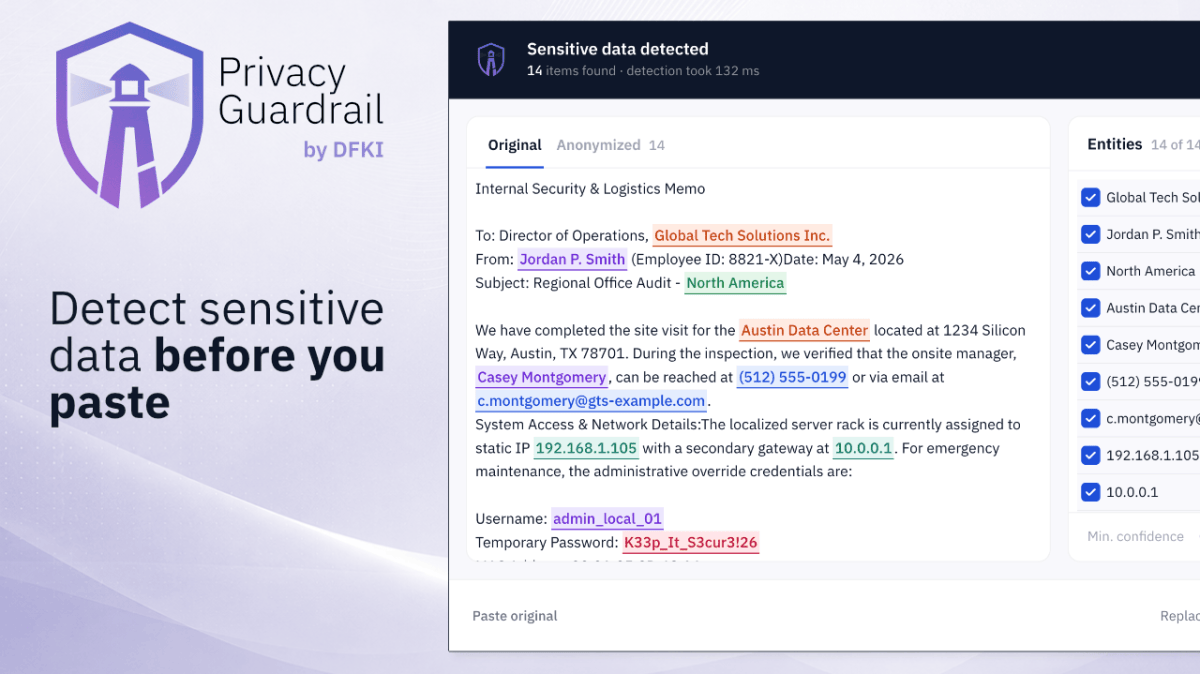
Screenshot von "Privacy Guardrail" filled with test data

“Privacy Guardrail” shows the sensitive data detected using regex and local AI. The threshold values ​​for detection can be individually adjusted in the settings.

According to the source code, the synthetic mode deliberately uses placeholders for particularly sensitive categories such as passwords, URLs and dates, as generating realistic fake passwords or URLs is considered too risky. The extension manages the mapping between the original value and replacement value in a local “Identity Vault” in the browser profile – without synchronization via Chrome Sync. This will allow AI responses to be de-anonymized locally later, and replacements will remain consistent across sessions and platforms.

Two levels of detection

Technically, Privacy Guardrail combines two processes. A rules-based engine – implemented in Rust and compiled to WebAssembly – recognizes structured data such as email addresses, credit card numbers, IBANs or IP addresses. Optionally, a local AI model supplements the recognition with context-dependent information such as names, organizations or addresses. According to the repository, a multilingual NER model based on XLM-RoBERTa is used, which is intended to cover 24 European languages ​​and 36 entity classes. The model runs via ONNX Runtime Web directly in the browser and uses WebGPU for acceleration when available. Without GPU support, execution takes place via CPU or WASM, which, according to DFKI, can be significantly slower.

High hardware requirements

Read more after the ad

The local AI component places comparatively high demands on the hardware. The DFKI recommends at least 16 GB of RAM and a WebGPU-capable GPU. Below 8 GB of RAM, the extension automatically deactivates AI recognition and only works with rule-based pattern recognition.

The DFKI expressly points out limitations. The detection could overlook sensitive content or incorrectly mark harmless content. Short names, ambiguous terms, tables, code blocks or unusual formatting reduced the recognition quality. Privacy Guardrail is therefore not a DLP or compliance solution, but an assistive protection layer.

In addition, the expansion is limited to three platforms in the current beta: ChatGPT, Claude and Gemini. Other AI chat services, browser-based tools, or internal business applications are not supported.

The development team plans to support smaller models, more efficient inference paths for low-resource devices, and additional browsers and mobile platforms. The source code of the Privacy Guardrail browser extension is available on GitHub under the Apache 2.0 license; The finished extension can be installed directly from the Chrome Web Store.


(v.a.z.a.)


Unfortunately, this link is no longer valid.

Links to gifted items will be invalid if they are older than 7 days or have been accessed too often.


You need a heise+ package to read this article. Try it now for a week without obligation – without obligation!

Sign Up For Daily Newsletter

Be keep up! Get the latest breaking news delivered straight to your inbox.
By signing up, you agree to our Terms of Use and acknowledge the data practices in our Privacy Policy. You may unsubscribe at any time.
Share This Article
Facebook Twitter Email Print
Share
What do you think?
Love0
Sad0
Happy0
Sleepy0
Angry0
Dead0
Wink0
Previous Article French consortium wants EU billions for AI data center French consortium wants EU billions for AI data center
Next Article US startup with rental service: Will this robot soon clean your apartment? US startup with rental service: Will this robot soon clean your apartment?
Leave a comment

Leave a Reply Cancel reply

Your email address will not be published. Required fields are marked *

Stay Connected

248.1k Like
69.1k Follow
134k Pin
54.3k Follow

Latest News

after Claude and ChatGPT, it is Gemini who makes his entrance
Mobile
US startup with rental service: Will this robot soon clean your apartment?
Gadget
French consortium wants EU billions for AI data center
News
China is trying another way to surpass the US number one
Gaming

You Might also Like

Robotics researcher Burgard: Why humanoid robots are still in their early stages
Software

Robotics researcher Burgard: Why humanoid robots are still in their early stages

2 Min Read
Nvidia graphics card drivers vulnerable under Linux and Windows
Software

Nvidia graphics card drivers vulnerable under Linux and Windows

2 Min Read
Union reaches agreement with Samsung: strike averted at the last minute
Software

Union reaches agreement with Samsung: strike averted at the last minute

4 Min Read
Nvidia: Everything for investors – players go under
Software

Nvidia: Everything for investors – players go under

5 Min Read
//

World of Software is your one-stop website for the latest tech news and updates, follow us now to get the news that matters to you.

Quick Link

  • Privacy Policy
  • Terms of use
  • Advertise
  • Contact

Topics

  • Computing
  • Software
  • Press Release
  • Trending

Sign Up for Our Newsletter

Subscribe to our newsletter to get our newest articles instantly!

World of SoftwareWorld of Software
Follow US
Copyright © All Rights Reserved. World of Software.
Welcome Back!

Sign in to your account

Lost your password?