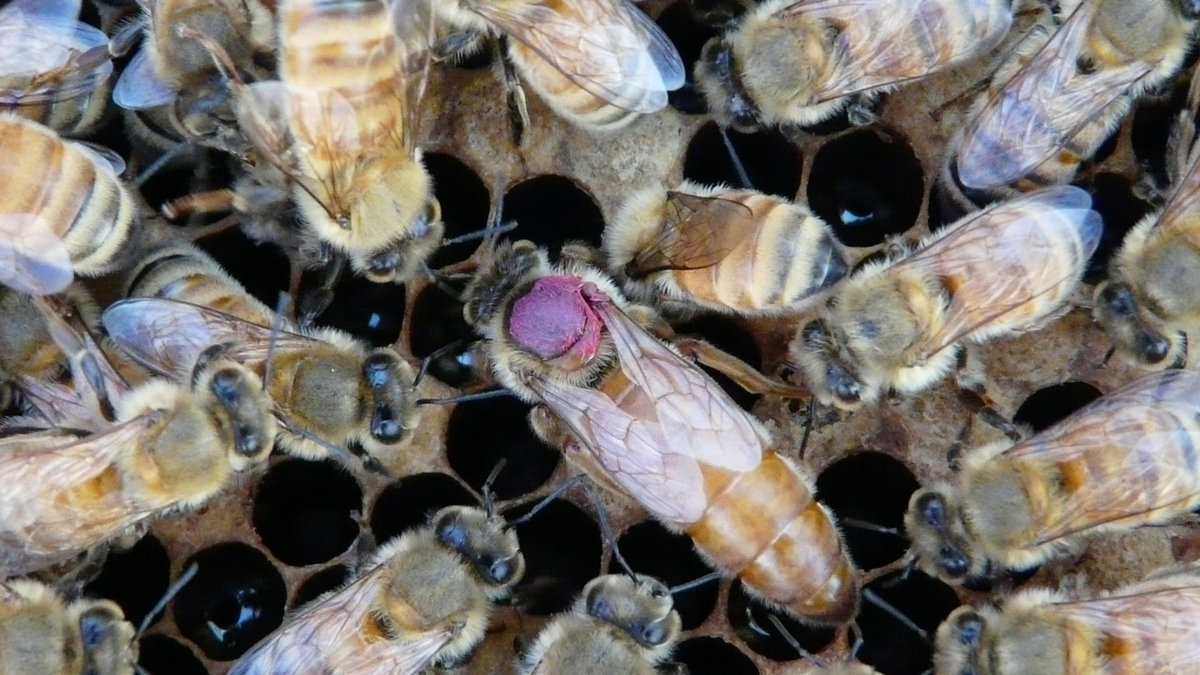
In collaboration with the Lawrence Livermore National Laboratory (LLNL) and the United States Department of Agriculture, research led by the University of California, Davis, has revealed a surprising defense mechanism in queen bees.
Published in the journal Current Biology, the study shows that faced with chronic exposure to pesticides, the queen transfers contaminants into its eggs to ensure its own survival.
When protecting workers is no longer enough
The process, called maternal discharge, is a first documented in bees. ” In order to protect herself, the queen bee discharges these chemicals into her eggs to get rid of them “, explains Sascha Nicklisch, lead author of the study.
It was accepted that queens are protected by workers who filter the food. However, research suggests that filtration capacity of workers can be exceeded, and pesticides can accumulate in queens over time.
When this threshold is reached, the queen activates her own defense mechanism, transferring the toxic burden to her offspring.
What method made it possible to make this discovery?
To observe this phenomenon, the researchers used nanocolonies containing a queen and 60 workers. They fed the bees with pollen contaminated with parathion methyl, a pesticide marked with a radioactive tracer to follow its journey through the body and the hive.
Using LLNL’s biological accelerator mass spectrometry (BioAMS) technology, the team was able to follow very low levels of pesticides. The concentrations of pesticides used were not lethal and corresponded to what is observed in nature.
The results showed that while the workers filtered 95% of the pesticide on the first day, this figure dropped to 86% on the tenth dayleaving the queen more exposed.
A feared tipping point with pesticide exposure
Queens can lay up to 2,000 eggs per day, ensuring the renewal of the hive that pollinates about a third of the world’s food crops. Accumulation of pesticides in eggs could lead to delayed colony collapse.
NB: Source image (vignette): Sascha Nicklisch / UC Davis.