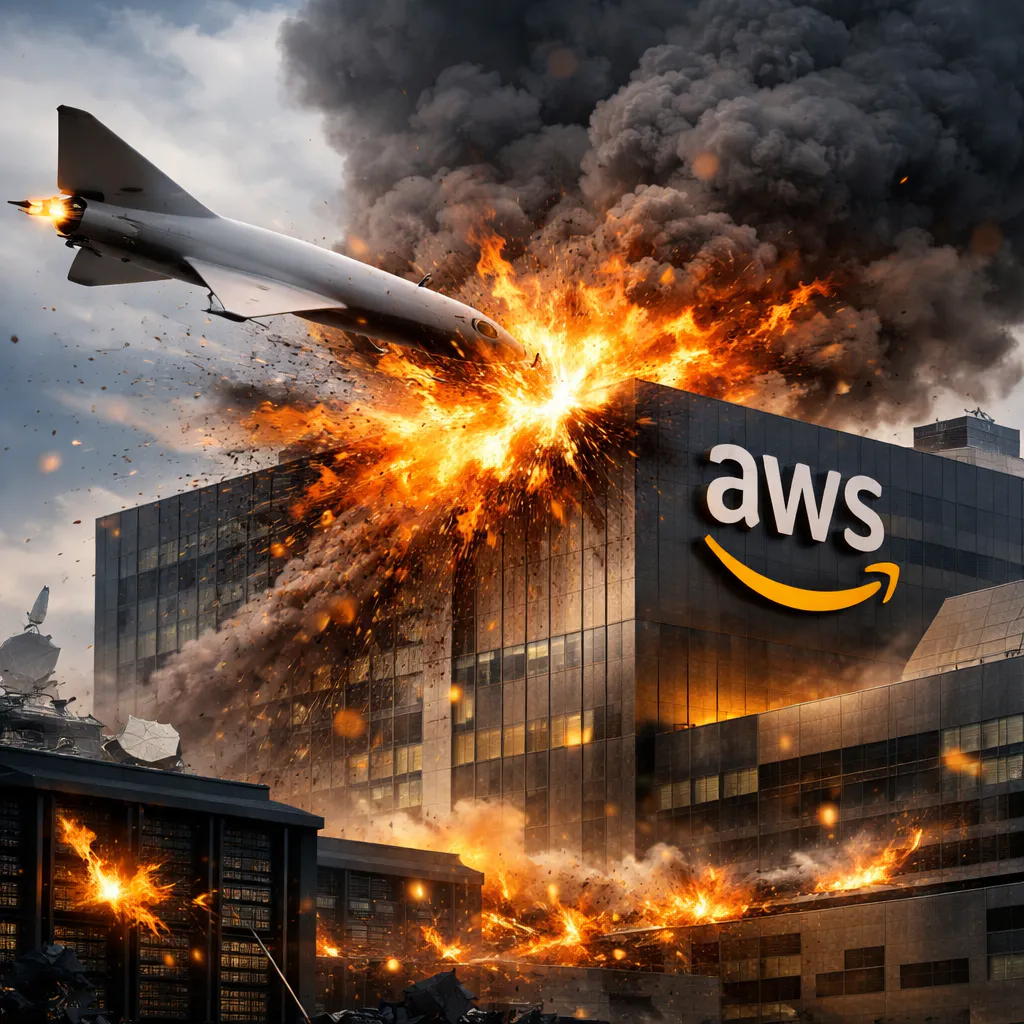
When “Multi-Region Strategy” Means “Outrunning a Military Conflict”
So last week a military drone blew up the AWS data center where my customer’s platform runs. The platform serves millions of users across seven countries. I had to spend about a week moving everything from Bahrain to Europe. By hand. Because every single automated migration tool was also broken. Because, you know, the drones.
I run a software consultancy. I’ve been in tech long enough to have planned for almost every disaster imaginable. Floods, earthquakes, ransomware, that one guy who drops the production database on a Friday afternoon. “Military drone strike on your cloud provider” was never on the list.
And Bahrain is not an isolated case. Right now, data centers in more than ten countries are being targeted or threatened by either Iranian or russian drones. This isn’t a regional incident. It’s a global pattern.
And yet, here we are. Welcome to DevOps in 2026.
Disaster Recovery Used to Mean Hurricanes. Now It Means Drones.
If you’ve worked in infrastructure long enough, you’ve imagined the disaster scenarios. An earthquake takes out a data center in Tokyo. Hurricane floods a facility in Virginia. Maybe a biblical-scale power outage somewhere in Texas (actually, that one happens pretty regularly). You build for resilience, you plan your failovers, you sleep slightly less terribly at night.
And I don’t say “earthquake” lightly. Exactly a year ago, my wife and I were on the top floor of our skyscraper condo in Bangkok when a 7.7 magnitude earthquake hit. One second I was pushing a commit. The next second I was crawling on the floor. The building was swaying two meters each side, and water from the rooftop pool came crashing through into our living room. I still get flashbacks from that. So yes, I understand natural disasters on a very personal, visceral level. I expected those to be the thing that would eventually force me to move servers under pressure.
What I never rehearsed was: “Your entire AWS region is down because a military drone hit all availability zones in Bahrain.”
Yet here we are.
In early March, Iranian drones struck multiple AWS facilities across the UAE and Bahrain. This wasn’t some theoretical threat model from a security conference whiteboard. This was the first confirmed military attack on a major hyperscale cloud provider’s infrastructure. Banking apps went down. Payment systems collapsed. Delivery platforms across the Gulf went dark. And somewhere in Thailand, my phone started buzzing with messages from a very worried customer in Saudi Arabia.
There’s No Terraform Module for Surviving a War Zone
Here’s what you need to understand about the week that followed: every single automated migration tool AWS provides was broken. CloudWatch, the thing that tells you if your servers are even alive? Gone. RDS Snapshots, the thing you use to back up databases before you touch anything? Unavailable. Cross-region transfer? Dead. AMI copies? Nope.
It was like showing up to a house fire and discovering that not only is your fire truck empty, but someone also stole the hydrant.
So I did what any reasonable engineer would do. I had to rebuilt multiple production environments from scratch, on bare Linux images, in Europe. By hand. For a platform serving millions of users across seven countries. I wrote custom scripts to export, compress, and transfer everything over the public internet (because AWS’s own internal backbone between regions was also down). I wrote manual rescue scripts for files that kept failing for days with InternalError. I worked nights because often it was the only window where platform traffic was low enough to safely verify everything.
One week of controlled chaos. And by the end of it, the entire platform was running smoothly from Europe, as if nothing had happened.
But everything had happened.
We’re a Software Company. Why Do We Keep Running From Wars?
I could tell this story as a purely technical narrative. Here’s the architecture, here’s the migration plan, here’s the clever script that saved the day. But that would miss the point entirely.
Because here’s what my day-to-day actually looks like:
I run a small tech consultancy. We build custom software. We manage cloud infrastructure. We automate businesses with AI workflows. Very normal stuff. And yet somehow, every single person on my team has been touched by war. Not metaphorically. Literally.
I live in Thailand, which recently had skirmishes with Cambodia along the border. My Iranian engineer had to flee Iran with his entire family. One of my coworkers lives in Ukraine, literally in a war zone, delivering code between power cuts because the grid keeps getting hit by Iranian-designed drones. A couple of months ago he went to an immigration office across the border and couldn’t come back for days because russians bombed the only bridge on his route home. Another colleague had to evacuate Ukraine with his whole family.
We write code and configure servers. We’re not defense contractors. We’re not geopolitical analysts. We’re developers who just want to ship clean code and go home.
And yet, every week, somewhere on this planet, a conflict reaches through the internet cables and grabs us by the collar.
The Strangest Plot Twist of 2026
And now, in what might be the most unexpected geopolitical crossover episode of the decade: Ukraine is protecting Saudi skies.
Let that sink in for a second. The country that has been fighting for its own survival since 2022, that has become the world’s foremost expert on shooting down drones because it had no choice, has just signed defense cooperation agreements with Saudi Arabia, Qatar, and the UAE. Over 200 Ukrainian drone-countering specialists are now deployed across the Gulf, helping defend the very region where my customer’s servers used to live.
The same drones that forced me to migrate infrastructure out of Bahrain? Ukraine knows those drones intimately. They’ve been dealing with their Iranian-made cousins, the Shaheds, for years.
So now the country of my colleague who codes between blackouts is also the country protecting the airspace above my customer’s business. If you wrote this as fiction, your editor would tell you it’s too on the nose.
Who Else Is Living This?
I can’t be the only one. There must be thousands of engineers, sysadmins, CTOs, and DevOps folks out there who have spent the last few years making decisions that no technical manual covers. Moving workloads because of missiles. Rerouting traffic because of sanctions. Keeping systems alive through infrastructure that’s being actively targeted.
If you’ve had to migrate production systems because of armed conflict, I’d love to hear your story.
The New Normal (Which Is Not Normal At All)
Twenty years ago, your biggest infrastructure worry was a hard drive failing or router dropping packets. Ten years ago, it was maybe a ransomware attack. Today, it’s a state-sponsored drone strike on your cloud provider’s physical data center.
We’ve entered an era where “disaster recovery” needs to account for actual disasters of the military kind. Where your multi-region strategy isn’t just about latency and compliance, it’s about geopolitical risk assessment.
The conflicts we see on the news aren’t happening “over there” anymore. They’re happening inside our dashboards, our uptime monitors, our incident channels. Every single one of us in tech is connected to these events whether we like it or not.
The world got very small, and very complicated, very fast.