Millennials and younger members of Gen The musician’s penchant for repeatedly installing relatively pointless accessories such as an aquarium, a juice bar or a pool table in the cars gives rise to the so-called “Yo Dawg” meme. This refers to the idea of cramming products with as many other products as possible, often against the will of the user. To me, the current trend of building generative AI into everything that isn’t on three is the modern equivalent of this idea. And if you look at the announcements from this year’s Google I/O, Google product managers seem to be obvious fans of the MTV format.
AI overviews in search, for example, are unlikely to have arisen from a request from users. It is unclear whether and how these are actually used. According to CEO Sundar Pichai, the feature has 2.5 billion active monthly users. But that is probably also because, according to an Ahrefs analysis from November 2025, the function appears on average in 20 percent of all inquiries examined. For search queries with more than seven words even 46 percent. Whether users want this function now or reject it: in many cases they have to see it anyway. But that doesn’t seem to be enough for Google.
Will manual searches become unnecessary?
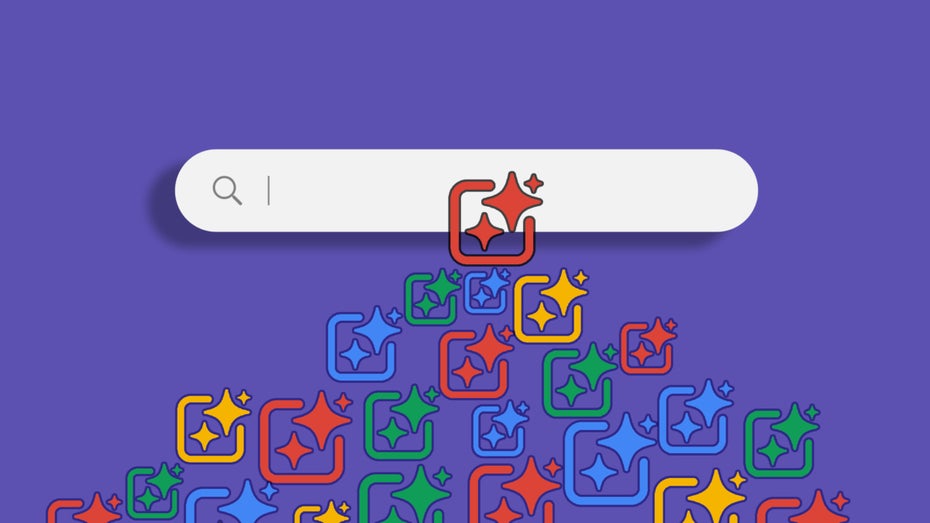
The normal search bar, which was AI-free for a long time, will now be gradually transformed into a search box with a chatbot connection, which ultimately looks like a ChatGPT input mask. That’s understandable at first. After all, according to internal OpenAI evaluations for ChatGPT and, for example, in a current TÜV study, AI chatbots are mainly used to collect information. On paper it makes sense to combine the two. Especially when you, like Google, have such dominance in search and online advertising. For example, because Google favors itself in the adtech sector, the EU has imposed a billion-dollar fine in 2025.
Editorial recommendations
${content}
${custom_anzeige-badge}
${custom_tr-badge}
${section}
${title}
Nevertheless, the company wants to further advance its fusion of generative AI and search functions. People should play less and less of a role. In the future, assuming a well-stocked wallet and the corresponding Pro or Ultra subscription, AI agents will carry out searches independently and always-on models like Gemini Spark will organize our entire lives. Google also wants to revolutionize online shopping. It sounds to me as if the company wants to squeeze all sorts of functions that the competition has been offering in various facets into its search product and want to deepen and centralize its market power even further. The idea behind it isn’t bad at all.
Because Google search has become somewhat unusable for years. The “Ten Blue Links” maxim is long gone. Search results pages are plastered with Google’s own widgets that promote related searches, YouTube videos and now AI overviews. A cleaner search experience would also be desirable in my opinion. But generative AI, which is still prone to errors and tends to fabulate, is the wrong approach. Above all, this could prove to be damaging to Google’s business.
AI is not the upgrade that Google Search needs
Because the tech company made around three quarters of its sales from ads in the 2025 fiscal year. Ads that were responsible for more than 50 percent of sales in the context of online searches. If search agents comb the Internet in the future and no one sees or clicks on normal search engine advertising, then Google could at least partially cannibalize itself. The fact that Gemini 3.5 Flash, the new standard for the AI mode, costs around five times as much as Gemini 3 Flash, according to Artificial Analysis, is also likely to influence this calculation.
This can be compensated for in theory. For example, the company integrates links to products or direct advertisements into the agent reports, the AI answers or the dashboards created using agentic AI. In return, the company can then ask advertising customers to pay. Like OpenAI, which recently started testing advertising for free users of ChatGPT. But advertisers don’t seem to be completely convinced of the model either. There is also a possible loss of trust. If Google has its way, Gemini will soon be included in all search queries. It is not unthinkable that sensitive chats with Gemini, for example, also find their way into the search tools. Not to mention emails, data in Google Drive or calendar entries. The close integration of apps in the Google ecosystem becomes a possible data protection trap.
It remains a pipe dream that Google will seize the opportunity and improve its search algorithms so that normal searches become more usable again. Ironically, the AI focus is an admission by Google itself that its search functionality has become less attractive. Because if you were able to get reasonable results like before, there would be no need for search agents to filter out AI slop and content farms. In the “Don’t be evil” era, Google was a kind of guardian of the Internet. Strives to display meaningful content and reward good content with visibility. Gemini and AI search agents will presumably take on this guardian function in the future. For me, this is a clear incapacitation of the users. It’s also another nail in the coffin for the idea of a free, open internet. Because it thrives on the content and perspectives of a wide variety of producers. A summary by an AI chatbot can never replace that.
See more in Google News:

Top Article
${content}
${custom_anzeige-badge}
${custom_tr-badge}
${section}
${title}