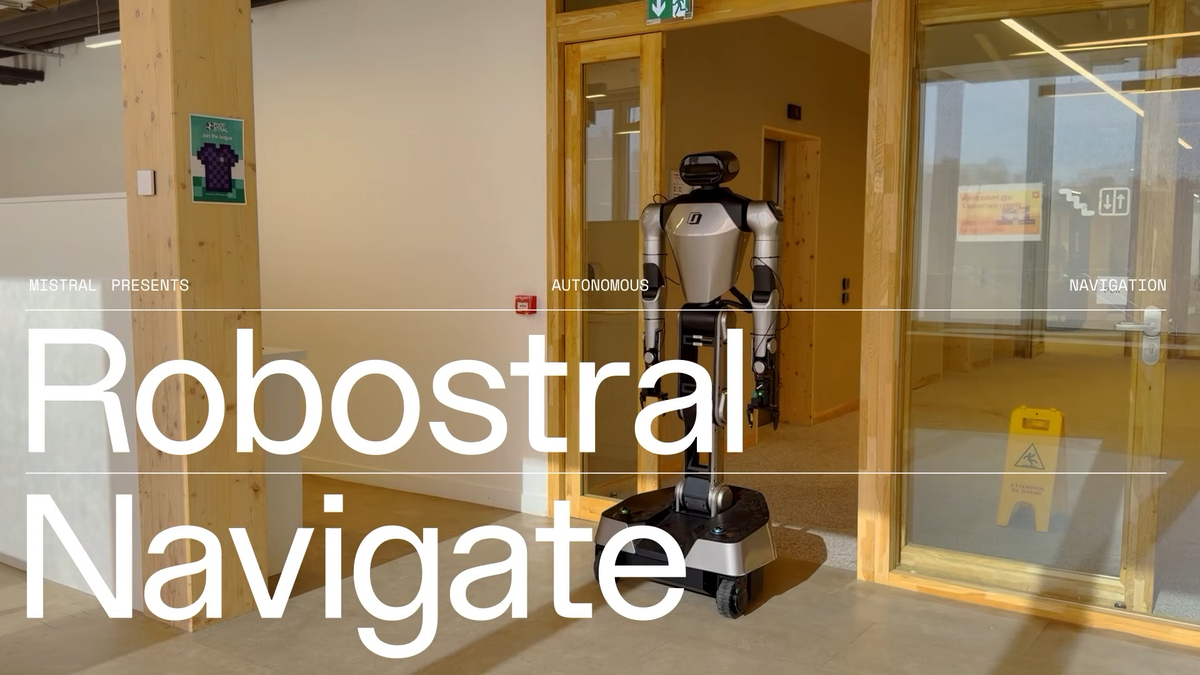
Mistral (Mistral AI) launches into robotics with Robostral Navigate. This robotic navigation model is designed to be compatible with a wide range of platforms, whether wheeled, legged or even flying robots of different sizes.
Compact with 8 billion parameters, it can work with a single RGB camera (or RGB) thus avoiding depth sensors or LiDAR, which are often expensive and complex.
Mistral claims that with an instruction to Robostral Navigate, a robot can navigate its way through a space filled with people and obstacles it has never seen before.
A model fully trained in simulation
Robostral Navigate is an entirely in-house design from Mistral, without depending on open source VLM (Vision-Language) models.
Mistral trained its model with a data generation chain entirely based on la simulation. It is a dataset of 400,000 trajectories which was created through 6,000 simulated scenes. A main technique called pointing allows the model to infer the coordinates of the target directly in the field of view of the camera.
To optimize the process, Mistral has developed a prefix-caching algorithm which reduces the token name necessary for training. Training cycles lasting several months would only require a few days.
After the supervised training phase, the model is refined by online reinforcement learning using the CISPO (Clipped Importance Sampling Policy Optimization) algorithm. Robostral Navigate can learn from its mistakes and has improved its success rate by 3.2%.
How does it perform compared to the competition?
On the R2R-CE (Room-to-Room in Continuous Environments) benchmark, Robostral Navigate achieves a success rate of 76.6% in unfamiliar environments.
This performance places it not only 9.7 points above the best competing model using a single camera (Alibaba’s Qwen-RobotNav-4B), but also 4.5 points ahead of the best system relying on depth sensors or multiple cameras (Qwen-RobotNav-8B).
Mistral emphasizes that Robostral Navigate can be deployed quickly on varied robot fleets, with control by operators not specialized in natural language. Prospects for industrial sectors such as logistics, delivery or manufacturing.