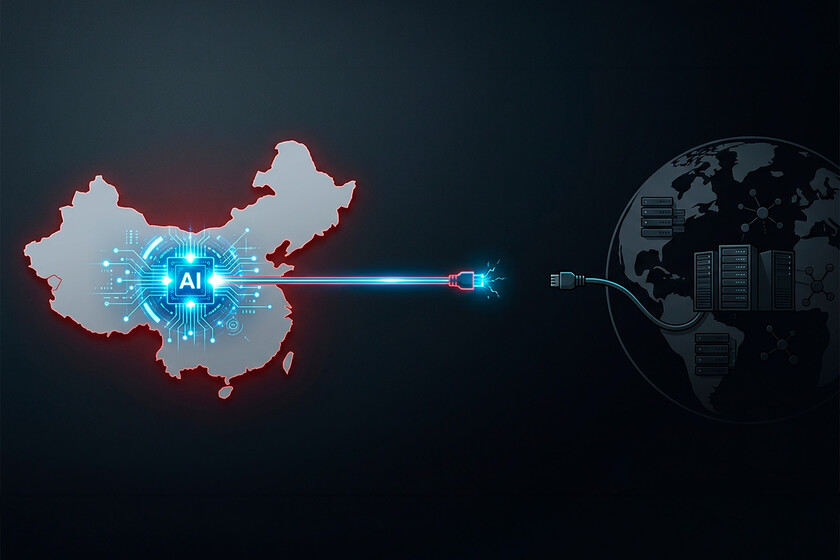
When the United States activated export controls that ultimately led Anthropic to disable Fable 5 and Mythos 5 for all its users, a reality that was difficult to ignore was exposed: access to advanced AI may be cut off. Not because the model disappears, nor because it stops working technically, but because a national security decision can convert an available tool into a conditioned capability. Things have changed slightly since then – controls on Fable were lifted after new safeguards and Mythos was limited to a few trusted US organizations – but the precedent is still there.
Now that question returns from the other side of the board. Reuters reports that Chinese authorities have held meetings over the last month with the country’s major technology companies to study possible restrictions on foreign access to their most advanced AI models, including some that have not yet been launched. Alibaba, ByteDance and Z.ai participated in those meetings, according to three people familiar with the conversations. At the moment there is no approved measure, no fixed calendar, nor definitive scope. Perhaps more revealing, Beijing is discussing how far it wants to open up its most advanced AI products.
What was discussed in those meetings goes beyond closing an API or limiting access to a specific product. According to the agency, participants talked about putting limits on the most advanced models, both closed and more open versions, and also about toughening the consequences for what they call leaks or thefts of proprietary AI technology. One of the sources consulted indicated that these leaks could be treated as crimes linked to China’s strict national security law. New restrictions were also raised on who can fund domestic AI startups.
Advanced AI enters the logic of strategic control
There are several reasons why what was mentioned does not remain solely within Chinese borders. Since the emergence of DeepSeek R1, remember, AI developed in China has gained ground outside the country thanks to a very attractive combination for many companies: low costs and increasing capabilities. Alibaba has Qwen, ByteDance has Doubao and Z.ai has attracted attention in Silicon Valley with GLM-5.2, a model that approaches leading American offerings at a fraction of the cost. If Beijing limits that access, many businesses and users could find themselves with fewer options and, presumably, higher bills.
The Chinese AI sector also seems interested in developing cybersecurity-oriented systems equivalent or superior to those in the United States. Zhou Hongyi, founder of 360, a cybersecurity company with weight among government and enterprise clients, has said China needs to develop its own Mythos. The company even presented Tulongfeng as a Chinese response to this type of system, stating that it is capable of detecting a large number of vulnerabilities.
This is where the most delicate part of the debate appears when viewed from Europe. When the Anthropic case raised the possibility that access to American models would be conditioned by Washington, some raised Chinese models as a possible alternative: cheaper, increasingly more capable and, in certain cases, available through API or with open weights. The new information from Reuters introduces an important nuance in that reading. Changing suppliers can reduce costs or open up new technical options, but does not eliminate the dependency if the critical capacity continues to live under a foreign jurisdiction.

Europe, moreover, had already been thinking about this kind of risk before Anthropic and China occupied the center of the discussion. The Commission has defended the need to reduce dependencies on cloud, artificial intelligence and semiconductors, and has linked that agenda with the continent’s digital autonomy and resilience. In this discussion, Brussels has come to warn of the risk of “kill switches”: the possibility that a foreign supplier or a government with the ability to pressure can interrupt essential technological services.
That is why Europe looks from the outside. The United States preserves some of the most advanced models in the world and has already made it clear that access to them may be conditioned by a political or national security decision. China, for its part, has gained ground with cheaper and increasingly capable modelsand now I would be studying my own restrictions. The Old Continent is in another place: it has regulation, sovereign ambition and promising companies, but it does not yet seem to have an equivalent in commercial weight, global adoption and strategic capacity to the products that today set the technological bar.
Images | with Nano Banana | Arthur Wang
In | Alibaba’s Qwen AI model is the new crown jewel. The only problem is that they don’t make money from it.